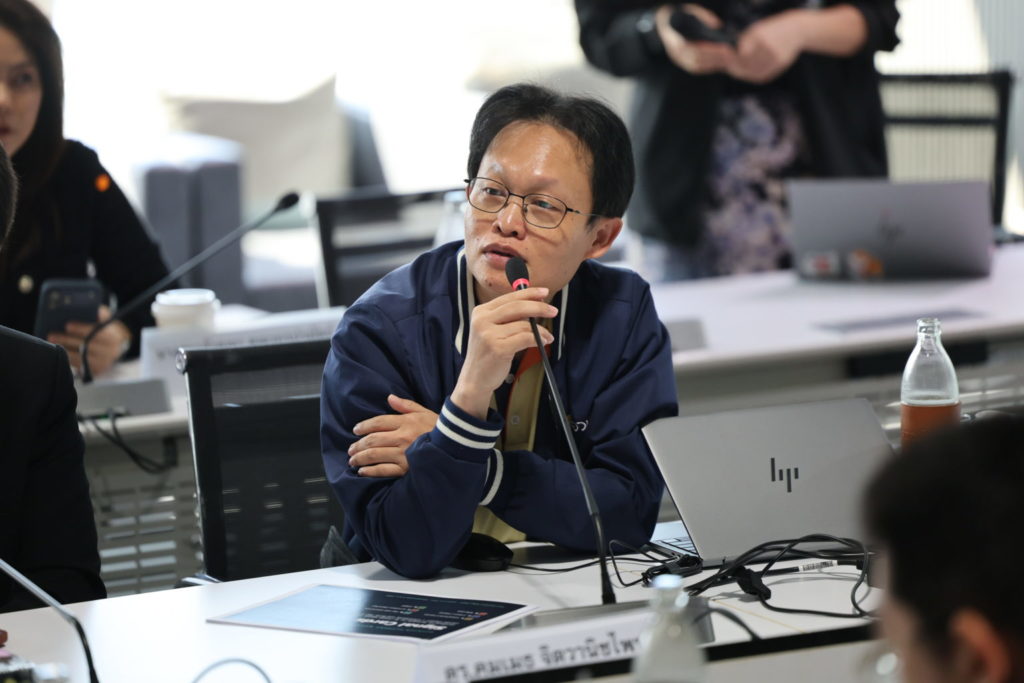
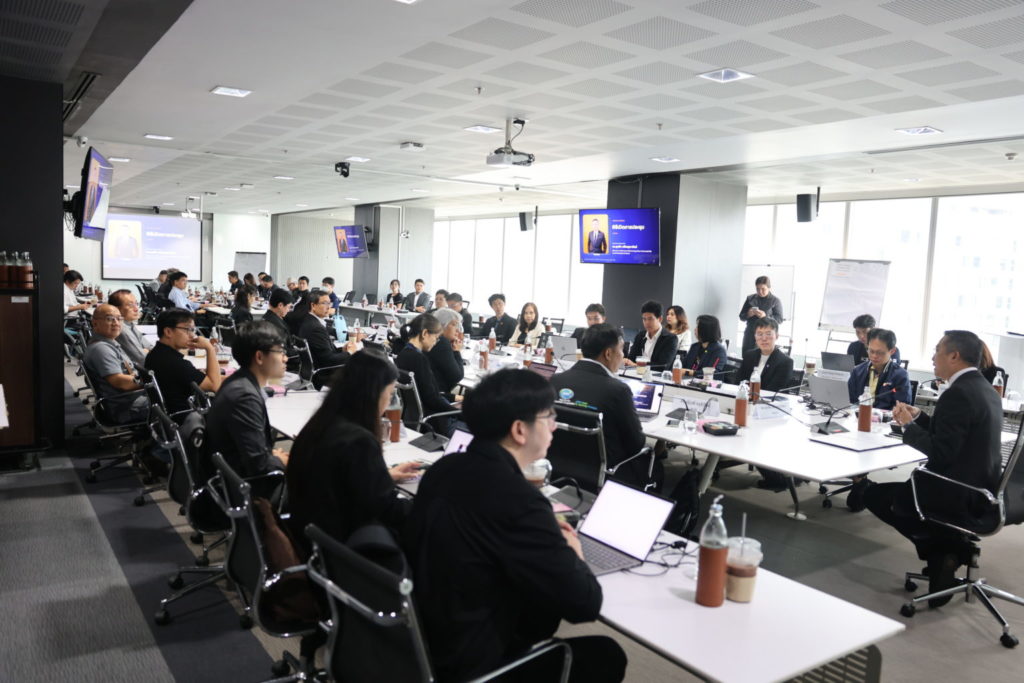
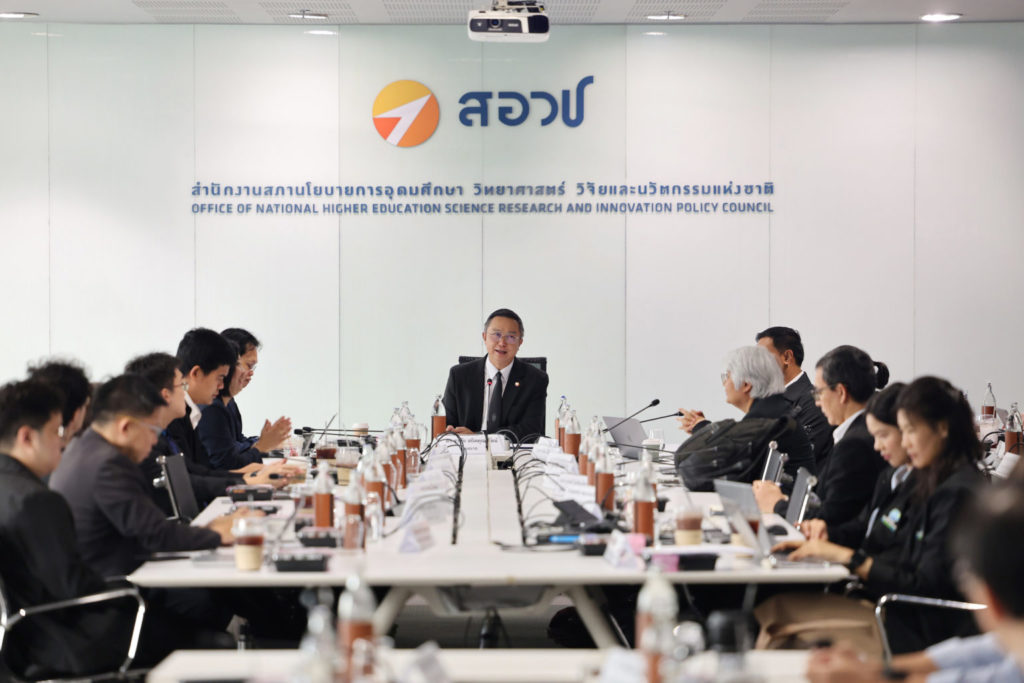
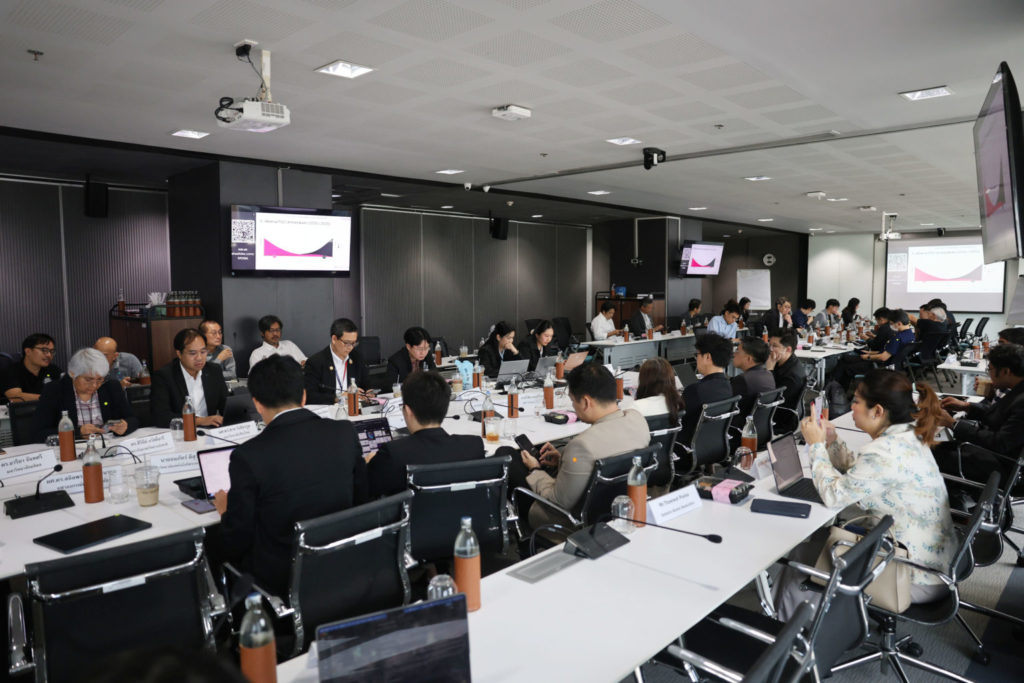
On 9 November 2026, NXPO organized a workshop titled “Strategic Foresight for Thailand’s Quantum Economy: From Scenarios to Strategy.” The event brought together more than 50 representatives from government agencies, the private sector, higher education institutions, and research organizations.
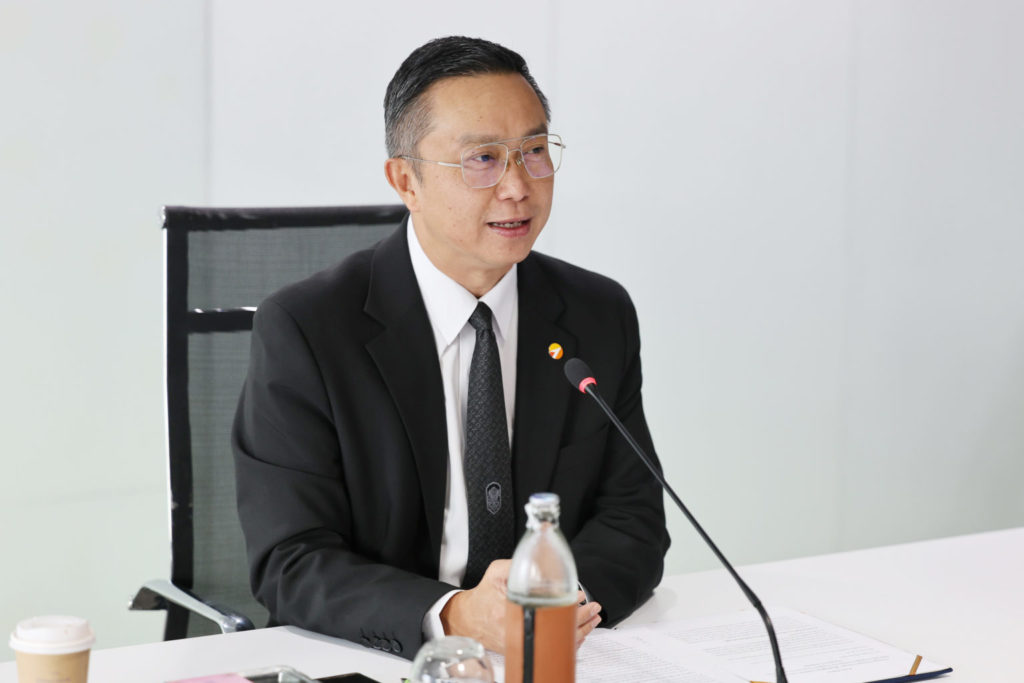
In his opening remarks, Dr. Surachai Sathitkunarat, President of NXPO, highlighted NXPO’s role as a policy agency for higher education, science, research and innovation, with a key responsibility for formulating policies for submission to the National Higher Education, Science, Research and Innovation Policy Council (Policy Council), chaired by Prof. Dr. Yodchanan Wongsawat, Deputy Prime Minister and Minister of Higher Education, Science, Research and Innovation. Prof. Dr. Yodchanan has emphasized the growing global investment in quantum technology and its significant potential to generate economic value. According to the Organisation for Economic Co-operation and Development (OECD), governments worldwide committed a total of USD 55.7 billion to quantum science and technology between 2013 and October 2025. McKinsey estimates that quantum computing could generate approximately USD 1.3–2.7 trillion in economic value across industries by 2035. These developments present significant opportunities for Thailand to advance quantum technology.
Under the leadership of Prof. Dr. Yodchanan, the Ministry of Higher Education, Science, Research and Innovation (MHESI) has designated quantum technology as one of its priority areas. At its meeting on 24 June 2026, the Policy Council approved four strategic directions for developing Thailand’s quantum economy: (1) accelerating the adoption of quantum technology in target industries; (2) advancing quantum-safe security; (3) establishing Thailand as a regional hub for workforce development; and (4) building on the country’s existing electronics and semiconductor industries to develop a supply chain for quantum hardware. In addition, on 17 July 2026, the Policy Council established the Quantum Economy Policy Committee, chaired by the MHESI Minister. Its members include representatives from economic agencies, cybersecurity and investment organizations, capital markets, industrial and financial sectors, as well as distinguished experts.
“This meeting represents an important step ahead of the upcoming meeting of the Quantum Economy Policy Committee. We will apply strategic foresight to identify emerging signals of change and key trends that could shape Thailand’s quantum economy by 2032, taking into account both technological advancements and geopolitical dynamics. These signals and trends will help us envision possible futures and then work backward to determine what actions Thailand needs to take to ensure that we are prepared for whatever form the future may take,” Dr. Surachai said.

Dr. Nattawut Anuniwat, Policy Specialist at NXPO, outlined the rationale and underlying principles of the Quantum Economy Initiative, emphasizing that policymaking cannot rely on a single forecast but must prepare for multiple possible futures. Strategic foresight is therefore being used as a tool for policy design, beginning with an horizon scanning process to identify emerging signals of change in the quantum field. These include signs of a shortage of skilled personnel, the transition to post-quantum cryptography (PQC), the convergence of quantum computing, high-performance computing, and artificial intelligence, and the readiness of the business sector. Participants were then invited to assess and score each signal based on its impact and degree of uncertainty. The results were used to prioritize key signals and provide initial inputs for developing scenarios for Thailand’s quantum economy in 2032. This was followed by a discussion in which experts from various sectors jointly explored possible futures for Thailand’s quantum economy across four key dimensions, leading to the following recommendations:
- Industrial Applications. The meeting proposed establishing an industrial sandbox to enable businesses to experiment with quantum technologies and apply them to real-world challenges while reducing investment risks. This should be complemented by a joint public-private funding mechanism. The goal is to position Thailand as a regional hub for quantum applications and infrastructure.
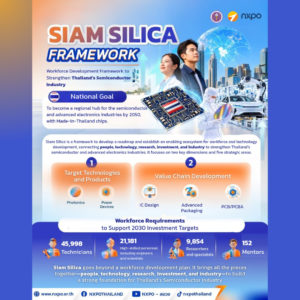
- Hardware, Supply Chains, and Sensors. Given the high degree of uncertainty surrounding quantum computer hardware and components, the meeting proposed strengthening supply chain resilience and analyzing Thailand’s strategic position to identify opportunities for integration into global supply chains. It also recommended building on the Siam Silica framework to accelerate implementation.
- Workforce and Talent Development. Participants identified several major challenges, including an insufficient supply of skilled personnel to meet market demand, the lengthy time required to develop quantum talent, and competition for professionals in this field. To address these challenges, they proposed developing a skill map to facilitate the transition of professionals from related disciplines into the quantum field, complementing conventional education and training pathways. They also recommended establishing educational infrastructure, particularly hardware and cloud infrastructure, as a central platform for collaborative talent development and training. In addition, a talent pipeline should be developed in collaboration with the Ministry of Education, starting at the secondary school level, potentially through science schools, to prepare students and expand the pool of future university students in the field.
- Quantum Security. The meeting proposed raising awareness of quantum- security and preparing personnel to support the transition, particularly among service providers. It also emphasized the need to ensure that businesses can access relevant services, especially smaller enterprises that may otherwise face high costs. In addition, the meeting recommended supporting research into quantum key distribution (QKD), which offers opportunities for further development in quantum communication and quantum computing.
The recommendations highlight workforce development, the establishment of sandboxes, and investment in infrastructure as fundamental pillars for advancing Thailand’s quantum economy. The results of the signal assessment will be used to develop scenarios for Thailand’s quantum economy, which will then be synthesized into policy recommendations for submission to the Quantum Economy Policy Committee and the Policy Council. These recommendations will also serve as the foundation for developing the National Quantum Economy Roadmap for 2028–2032.