Today, semiconductors are closer to our everyday lives than we might think. They are found in everything from smartphones, automobiles, and household appliances to data centers and AI technologies. As global demand for these technologies continues to grow, the semiconductor and advanced electronics industries have become strategic sectors in which countries around the world are competing to strengthen their positions.
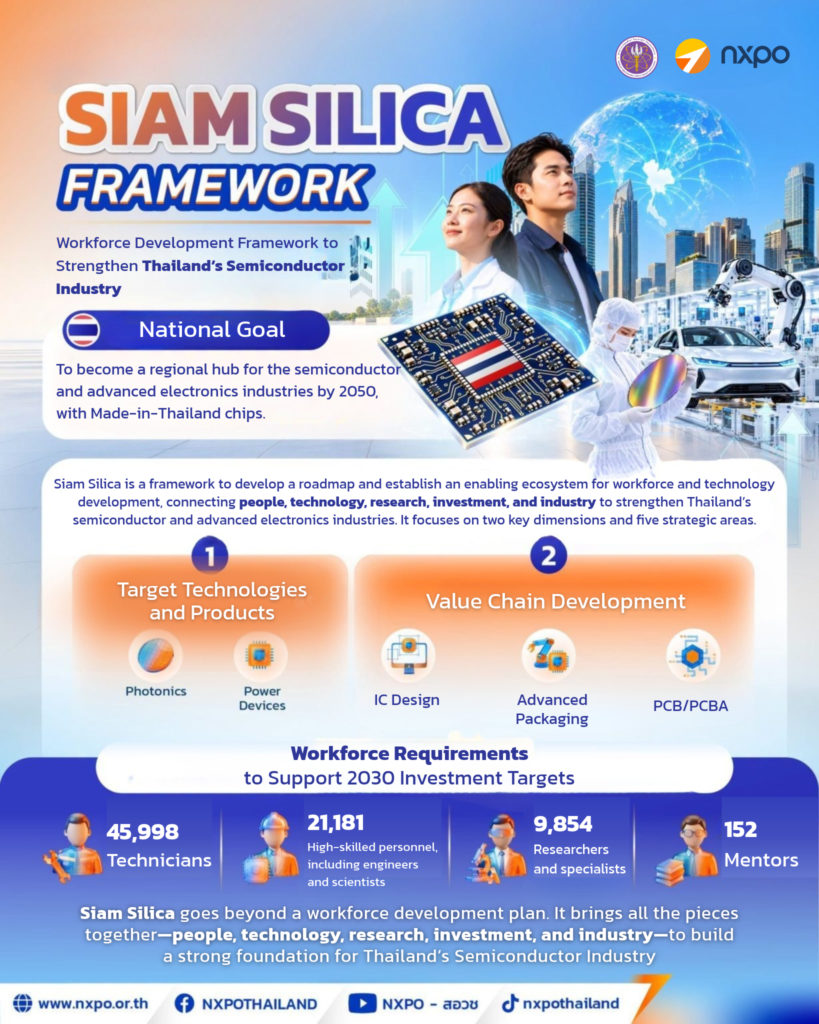
Thailand aims to become a regional hub for the semiconductor and advanced electronics industries by 2050, with chips manufactured domestically. To achieve this ambition, the Board of Investment (BOI) has developed the National Semiconductor and Advanced Electronics Strategy. The strategy seeks to attract investment from leading global companies while nurturing local industry leaders, with the ultimate goal of establishing a fully integrated value chain for the semiconductor and advanced electronics industries and promoting Made-in-Thailand chips.
Attracting world-class companies requires more than investment alone. Without a workforce equipped with the skills needed to support these industries, investment by itself may not be enough. Workforce development, therefore, must go hand in hand with industrial development.
In recent years, the Ministry of Higher Education, Science, Research and Innovation (MHESI), through its Office of the Permanent Secretary and NXPO, has piloted several initiatives to develop talent in the semiconductor and advanced electronics industries in close collaboration with the private sector. Key initiatives include:
🔹 Industrial internship programs through Coop+, a special cooperative education program designed in collaboration with industry.
🔹 Specialized undergraduate curricula developed under the Higher Education Sandbox and now offered at seven higher education institutions.
🔹 Targeted government scholarships for integrated circuit (IC) design, implemented in collaboration with Imperial College London. The program aims to equip scholarship recipients to establish IC design startups or develop technologies that serve the needs of Thailand’s industries.
🔹 National Semiconductor Training Centers (NSTCs), established as key mechanisms for developing a highly skilled workforce, with training programs covering the value chains of both the semiconductor and printed circuit board (PCB) industries.
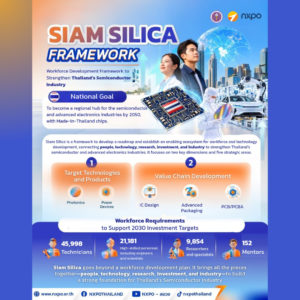
🚀 Building on these initiatives, Siam Silica has been introduced as a broader strategic framework. It aims to develop a roadmap and establish an enabling ecosystem for workforce and technology development, aligned with the BOI’s Semiconductor and Advanced Electronics Strategy. The program focuses on two key dimensions and five strategic areas:
🔸 1. Target Technologies and Products. This dimension prioritizes photonics and power devices, with development covering the entire value chain, from chip design and fabrication to assembly, testing, and packaging (ATP). It also encompasses quantum technology workforce development to prepare talent for the next phase of industrial advancement.
🔸 2. Value Chain Development. This dimension takes a broader approach to strengthening the semiconductor industry, covering IC design, chip assembly and testing, particularly advanced packaging technologies, as well as printed circuit boards and printed circuit board assemblies (PCB/PCBA).
🎯 The goal is not simply to increase the number of workers, but to identify precisely what types of talent Thailand needs, what skills they must possess, and how many are required. This will ensure that workforce development is closely aligned with actual and anticipated investment plans.
The Semiconductor and Advanced Electronics Strategy sets the following investment targets for 2030:
🔹 Eight IC design facilities
🔹 At least one photonics/power device fabrication facility
🔹 Two advanced packaging facilities
🔹 445 advanced electronics facilities
To support these investment targets, an estimated 77,185 additional personnel will need to be developed, comprising:
🔧 45,998 technicians
⚙️ 21,181 high-skilled personnel, including engineers and scientists
🔬 9,854 researchers and specialists
🎓 152 mentors
In addition, Siam Silica outlines workforce development plans across different skill levels and strategic technology areas, supported by a dedicated management mechanism through a Program Management Office (PMO). The PMO will coordinate collaboration among agencies within and beyond MHESI, industry, and educational institutions to advance workforce development, research, and innovation alongside industrial development, ensuring coordinated progress toward national targets.
📊 The vision behind Siam Silica goes beyond simply increasing workforce numbers. It seeks to establish an integrated system in which universities understand the areas of expertise they need to build and the talent they need to produce; the research sector identifies the technologies in which the country should invest; industries can access the skilled workforce they require; and policies on workforce development, technology, research, and investment are aligned toward a common goal.
🌏 Thailand’s opportunity in the semiconductor industry may not lie in doing everything independently. Rather, it lies in identifying where the country can best position itself in the global value chain and preparing the workforce, technologies, infrastructure, and support systems needed to capitalize on those opportunities.
Siam Silica is therefore more than a workforce development plan. It is about bringing all the pieces together—people, technology, research, investment, and industry—to build a strong foundation for high-value industries that can serve as new engines of economic growth for Thailand.