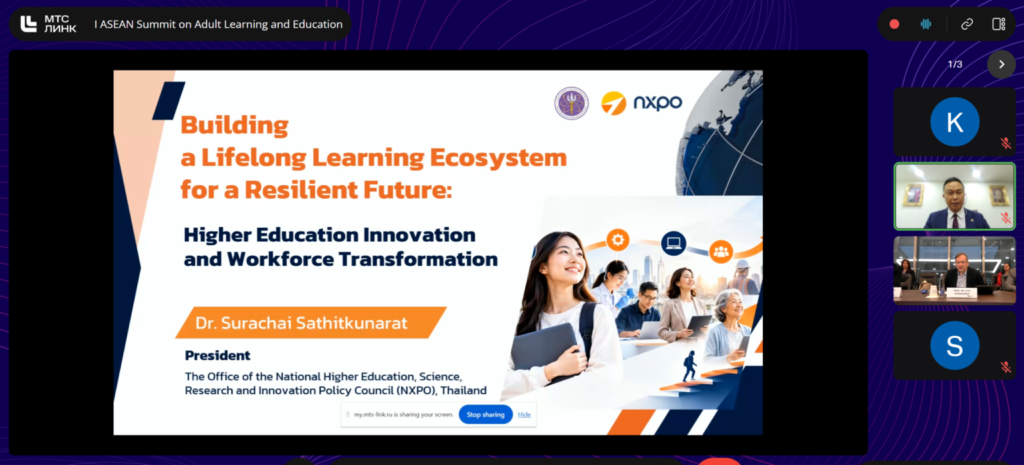
On 19 November 2026, Dr. Surachai Sathitkunarat, President of NXPO, delivered a presentation at the 1st ASEAN Summit on Adult Learning and Education, held at HSE University in Moscow, Russia, and online. His presentation was titled “Building a Lifelong Learning Ecosystem for a Resilient Future: Higher Education Innovation and Workforce Transformation.”
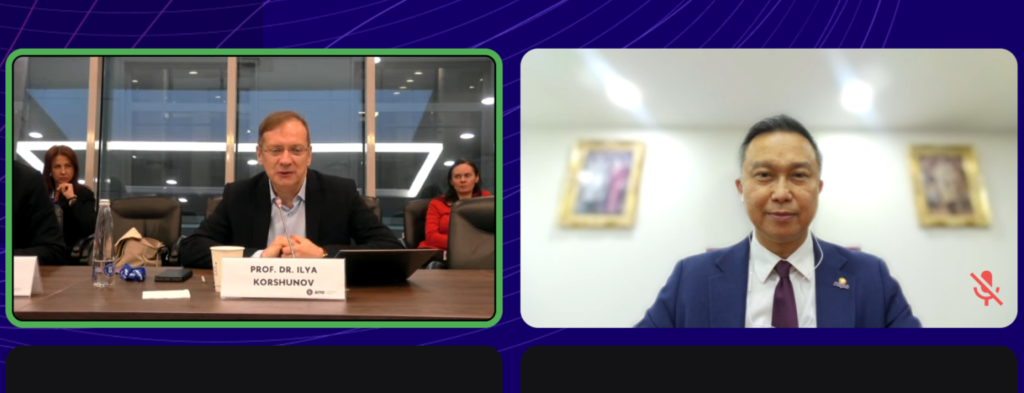

Dr. Surachai noted that Thailand is facing four major challenges closely linked to workforce demands and societal transformation: an aging society, climate change, geopolitical volatility, and global competition for talent. In response, the Ministry of Higher Education, Science, Research and Innovation (MHESI) has been advancing policies to support a “Multistage Life / Lifelong Workforce Journey,” which emphasizes human development at every stage of life, from early childhood and school age through working life and into old age. This approach focuses on continuous learning, lifelong reskilling and upskilling, as well as the development of a credit bank system and accessible funding mechanisms.
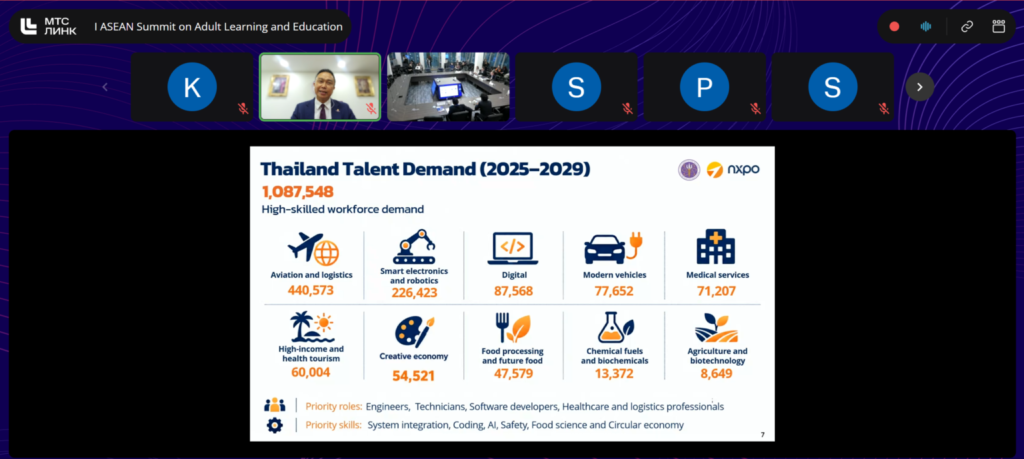
According to NXPO’s Thailand Talent Landscape 2025–2029, Thailand will need more than 1,087,548 highly skilled workers across targeted industries during this period. The industries with the greatest demand include aviation and logistics, requiring 440,573 workers; smart electronics and robotics, 226,423 workers; digital industries, 87,568 workers; next-generation automotive, 77,652 workers; medical services, 71,207 workers; and high-value and wellness tourism, 60,004 workers. Occupations in particularly high demand include engineers, technicians, software developers, and specialists in public health and logistics.
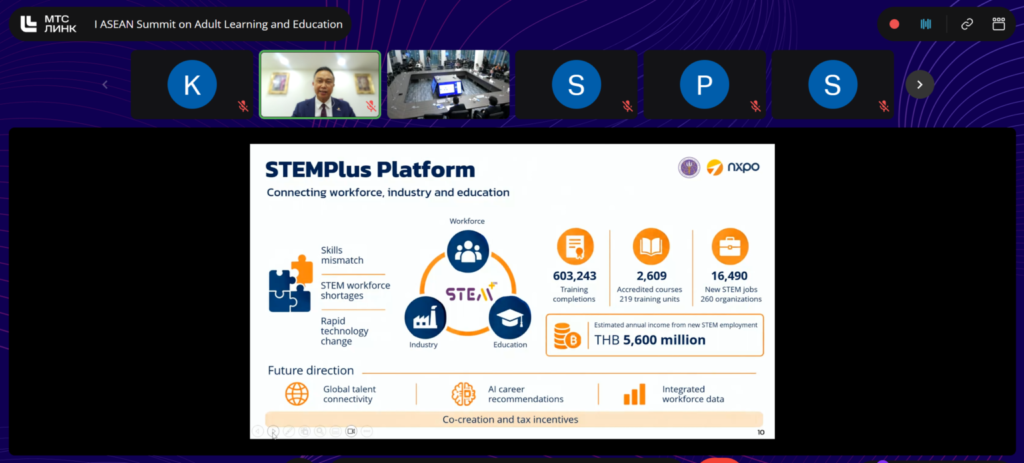
Dr. Surachai highlighted several key policy initiatives advanced by MHESI and NXPO to strengthen connections among educational institutions, industries, and learners. The STEMPlus Platform and STEM One-Stop Service serve as integrated mechanisms for workforce information management and job matching, covering the entire process from identifying workforce demand and accrediting training curricula to facilitating employment. To date, 603,243 people have completed training through 2,609 courses offered by 219 training providers. These initiatives have generated 16,490 STEM-related jobs across 260 organizations, contributing approximately THB 5.6 billion in annual economic value. The GenNX program emphasizes employer co-designed curricula and competency-based assessment to ensure that learners acquire skills aligned with industry needs. Its intensive bootcamps have achieved an employment rate of 86% among graduates, with participants’ incomes increasing by 2–6 times within three months. In addition, the Thailand Plus Package and BOI-STEM++ provide corporate income tax incentives to encourage companies to invest in employee training, STEM recruitment, and workforce development. Another important mechanism is the Higher Education Sandbox, which relaxes conventional constraints on study duration, credit requirements, and curriculum standards, enabling universities to develop more flexible and industry-responsive programs. One successful example is Chulalongkorn University’s Computer Engineering and Digital Technology (CEDT) program, a 3.5-year degree program developed in collaboration with more than 100 industry partners. Students gain hands-on work experience each year, equipping them with practical skills that directly meet industry needs upon graduation.
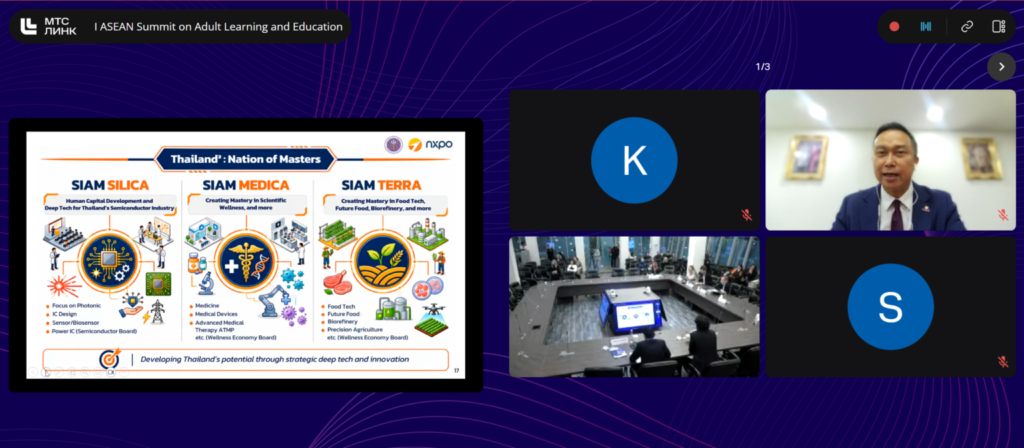
Dr. Surachai also presented MHESI’s “Thailand²: Nation of Masters” initiative, which aims to build national excellence in deep technology through three flagship programs: (1) Siam Silica – focusing on the semiconductor and advanced electronics industries, with targets to establish eight IC design centers and a domestic chip fabrication plant by 2030; (2) Siam Medica – advancing advanced medicine and scientific wellness; and (3) Siam Terra – promoting food technology and precision agriculture. Together, these programs aim to build a strong foundation for Thailand’s human capital and innovation ecosystem, supporting the country’s long-term technological advancement and competitiveness.