Thailand is facing multiple major challenges, from economic volatility, an ageing society, global warming, and inequality to wars, international conflicts, environmental regulations, and rapid technological change. Addressing these challenges through fragmented efforts may no longer be sufficient to achieve national goals.
Mission-Oriented Innovation Policy (MOIP) is an approach that places missions at the center of innovation policy to address complex national challenges through coordinated efforts across sectors, offering a transformative pathway for national development.
NXPO is adopting the MOIP approach to advance policies in higher education, science, research and innovation, particularly through the development of the Higher Education, Science, Research and Innovation Policy and Strategy Framework for 2028–2032, which aims to address national challenges and create new opportunities for Thailand.
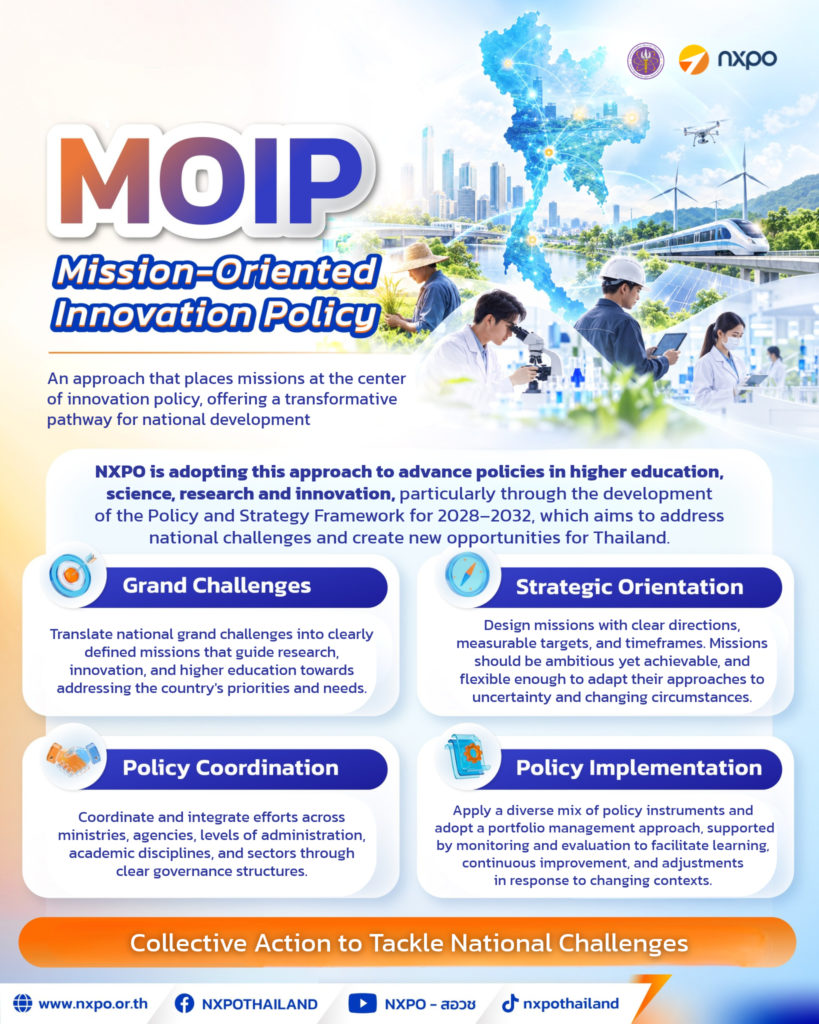
How does MOIP turn Thailand’s grand challenges into actionable missions?
🎯 Translate national grand challenges into clearly defined missions that guide research, innovation, and higher education towards addressing the country’s priorities and needs.
🧭 Design missions with clear directions, measurable targets, and timeframes. Missions should be ambitious yet achievable, and flexible enough to adapt their approaches to uncertainty and changing circumstances.
🤝 Coordinate and integrate efforts across ministries, agencies, levels of administration, academic disciplines, and sectors through clear governance structures.
🚀 Apply a diverse mix of policy instruments and adopt a portfolio management approach, supported by monitoring and evaluation to facilitate learning, continuous improvement, and adjustments in response to changing contexts. MOIP is another important approach that NXPO is embracing to advance higher education, science, research and innovation policies, deliver tangible change, and help steer Thailand towards a sustainable future. 🤝🌏✨