On 21 September 2026, Dr. Surachai Sathitkunarat, President of NXPO, participated in an online meeting of the Phetchaburi Rajabhat University Council, where he delivered a presentation on “Establishing a University Holding Company (UHC) in Public Universities.”

Dr. Surachai highlighted NXPO’s role as the national policy agency for higher education, science, research and innovation. One of NXPO’s key missions is to build an innovation ecosystem that promotes Innovation Driven Enterprises (IDEs) and develops research and innovation to align with the country’s needs and development directions. The University Holding Company (UHC) is a key mechanism for achieving this goal by enabling universities to co-invest with the private sector.
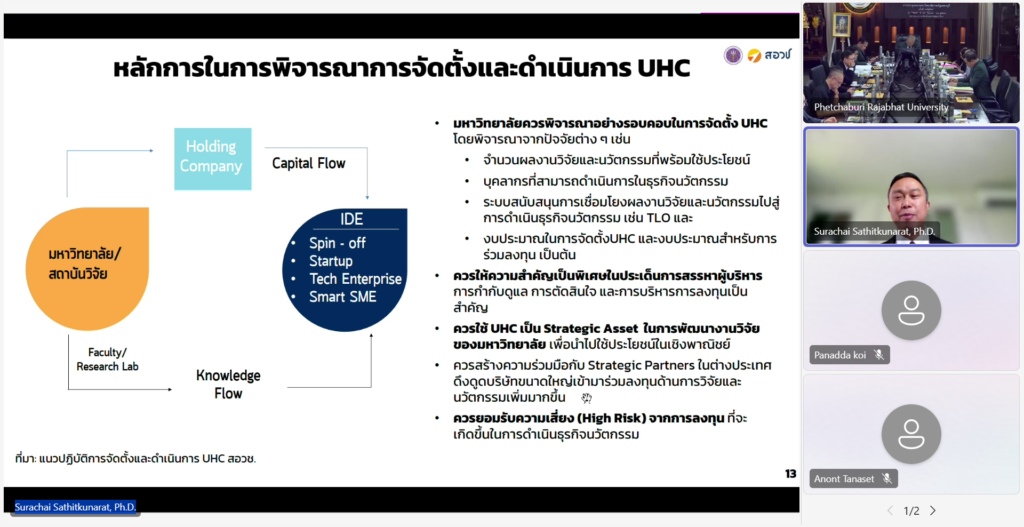
UHCs enable higher education institutions to more effectively commercialize research and co-invest with the private sector through business entities operating under private-sector principles. This approach helps reduce the constraints of the public administrative system and lessen reliance on government funding in the long term. NXPO has developed a policy to promote the establishment and operation of UHCs, which has been endorsed by the Policy Council. It has also developed the Prime Minister’s Office Regulation on Public-Private Partnerships in Projects Utilizing Research and Innovation and related guidelines, while enabling universities to use their own revenues to co-invest in innovation businesses. In addition, NXPO supports improvements to universities’ internal regulations to create a more conducive environment for investment. Key considerations for establishing and operating a UHC include research readiness, as well as personnel and support systems capable of driving research commercialization. Universities should also have sufficient funding to establish a UHC. The establishment of a UHC should emphasize professional management and risk management. Universities must also be prepared to accept business risks and regard the UHC as a strategic asset of the university.
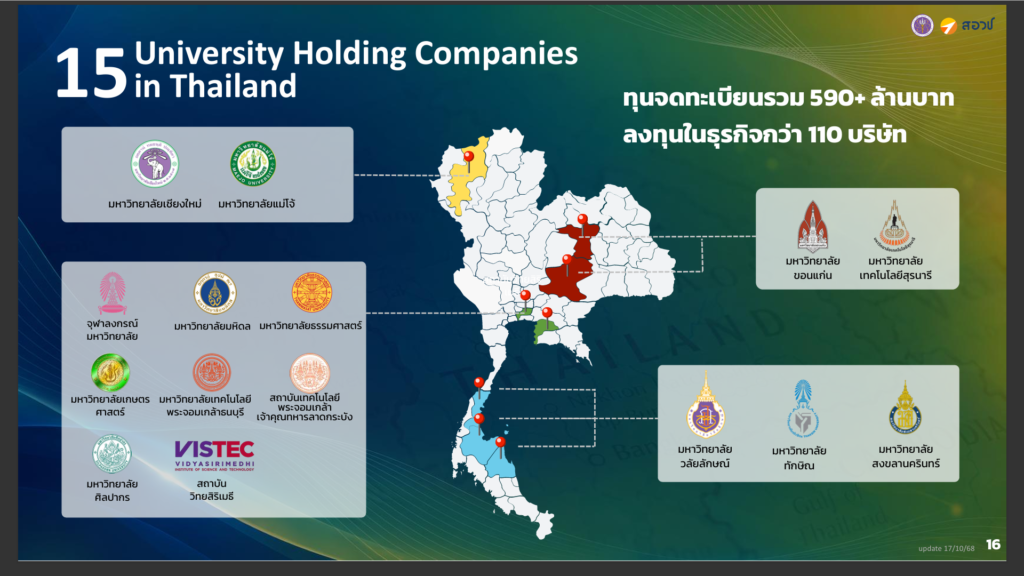
To date, 15 universities in Thailand have established UHCs across different regions. Together, they have a combined registered capital of more than THB 590 million and have invested in more than 110 companies. This demonstrates the tangible potential of research outputs and intellectual property to generate economic value.
As most UHCs in Thailand are still at an early stage of development, several areas require further strengthening. These include access to funding; business, financial, and investment management capabilities; mechanisms to connect universities with investors, industry, and government agencies; and the development of research outputs that are more commercially ready and responsive to market needs. To address these challenges collectively, NXPO supported the establishment of the UHC Consortium, in line with the policy set out by Prof. Dr. Yodchanan Wongsawat, Deputy Prime Minister and Minister of Higher Education, Science, Research and Innovation. The consortium aims to connect networks and resources, expand access to funding and markets, and collectively strengthen the capabilities of UHCs. It is open to universities that have already established UHCs as well as those preparing to establish one, providing opportunities to exchange knowledge and jointly improve their operations.
“We are very pleased that Phetchaburi Rajabhat University is interested in the UHC model. The university will need to review and adjust its internal regulations to facilitate such operations and NXPO is ready to support the university in this endeavor,” Dr. Surachai concluded.