Amid the challenges facing society today, Social Enterprise (SE) serves as a mechanism for transforming social problems into business opportunities, generating both income and positive social impact simultaneously.
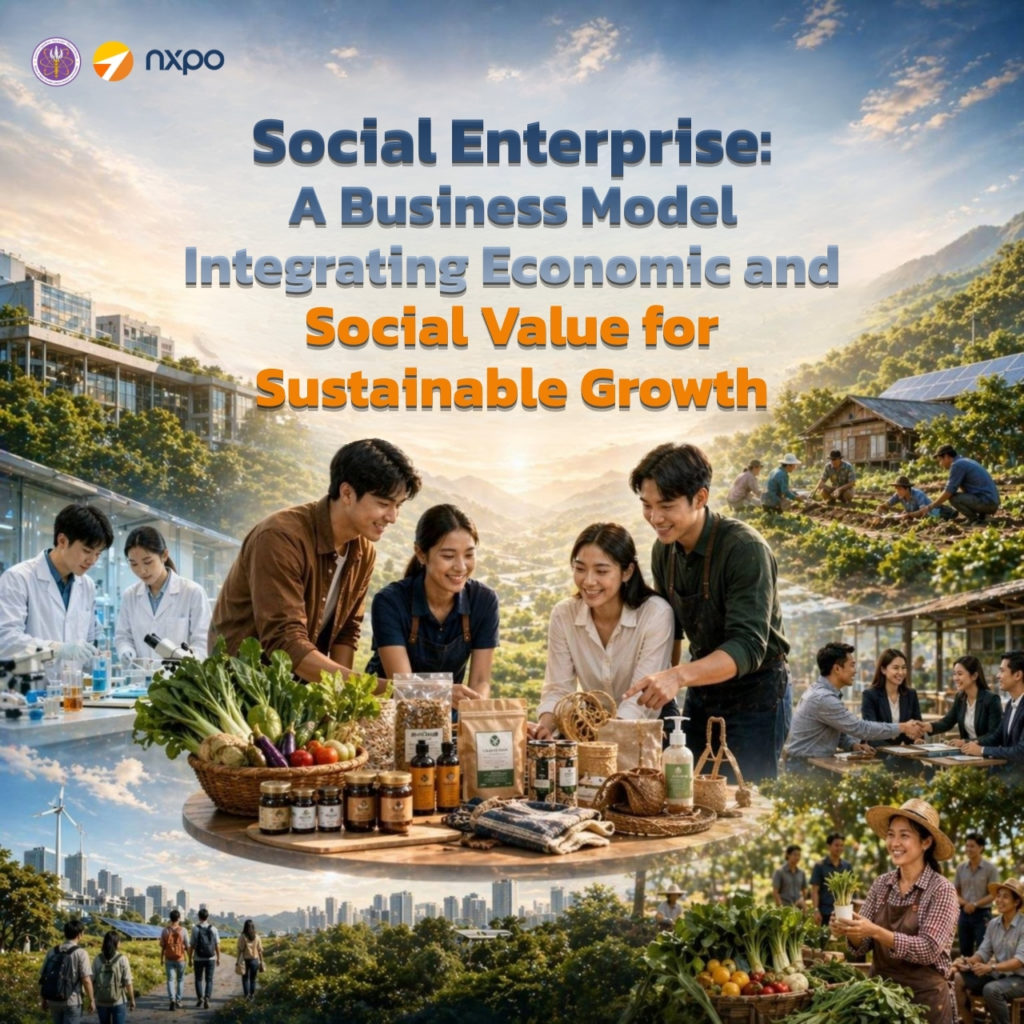
Under Thai law, an SE is defined as a company, partnership, juristic person, or other legal entity engaged in the production, distribution of goods, or provision of services with social objectives as its primary mission. NXPO further characterizes SEs as organizations that: 1) operate as hybrid entities combining public-benefit objectives with profit-generating activities; 2) are driven by social or environmental goals; 3) generate profits to sustainably support social missions while maintaining business viability; 4) are accountable to stakeholders and shareholders; 5) reinvest part of their income into social objectives and operational costs; and 6) can be established by the private sector, civil society, or government agencies. SEs allocate part of their revenue to generate social impact, such as creating jobs for vulnerable groups, strengthening local communities, conserving the environment, or adding economic value through local wisdom and cultural assets. SEs therefore represent a business model that systematically integrates economic and social value.
One of NXPO’s key roles is to drive policy development to strengthen Thailand’s SE ecosystem. In 2023, NXPO published a White Paper on Social Enterprise Promotion to establish a policy framework that positions higher education, science, research and innovation as drivers of economic and social development. The white paper outlines several policy recommendations, including: 1) establishing a Social Enterprise Academy to develop a new generation of social entrepreneurs; 2) developing social finance instruments such as Social Impact Bonds; 3) expanding funding sources and market access for SEs; 4) enhancing entrepreneurial skills and education systems; and 5) supporting the scaling of social impact generated by SEs. These recommendations aim to create an ecosystem conducive to the sustainable growth of SE in Thailand.
In addition, NXPO has developed the Social Enterprise Incubation Platform (SEIP), a mechanism designed to nurture social entrepreneurs by applying knowledge from higher education, science, research and innovation to strengthen business models and entrepreneurial capabilities. The platform also facilitates technology transfer and fosters collaboration networks among universities, the private sector, and local communities. Through these efforts, SEIP helps promote the sustainable growth of SEs while addressing social challenges through economic activities.
SEIP consists of four main programs: 1) knowledge enhancement; 2) coaching and mentoring; 3) social impact assessment systems; and 4) support systems and mechanisms. The incubation process involves three stages: 1) pre-incubation – building foundational understanding of SE concepts; 2) incubation – learning from exemplary entrepreneurs and case studies; and 3) post-incubation – assessing organizational readiness. By completing the incubation process, participants are expected to develop clear and practical social business models tailored to their organizational needs, enabling them to create business opportunities while effectively addressing social challenges.
One successful example emerging from SEIP is “ART STORY,” a brand developed under Thai Autistic Social Enterprise Co., Ltd. and the Autism Thai Foundation. ART STORY is a social enterprise that creates artworks and products produced by autistic children and individuals, including paintings, illustrations, design works, and handicrafts. The brand has partnered with Central Tham Social Enterprise Co., Ltd. to distribute products through Central Department Stores alongside the Good Goods brand. As the business continues to grow, it is creating more employment opportunities and generating income for vulnerable groups, particularly autistic children and individuals. This demonstrates how SEs can create tangible positive impacts for communities and vulnerable populations.
Another key initiative is the establishment of the “Impact SE Thailand: National Incubation & Acceleration Platform,” developed in collaboration with the Program Management Unit for Area-Based Development (PMU A), universities, and various partner organizations. The platform provides a comprehensive range of services, including area-based economic potential analysis, capacity-building programs through knowledge development institutions, SE incubation services, business acceleration, and access to funding opportunities. SEs participating in the platform benefit from services such as social impact assessment reports that can support grant or investment applications, close mentoring from coaches and experts, strategic business support, and network connections that enhance growth opportunities.
Through intensive policy-driven efforts, the growth potential of SEs in Thailand is becoming increasingly evident. At the same time, several areas still require further development over the next 5–10 years, including social finance systems, social impact measurement frameworks, networks of SE supporters, and incubation mechanisms for next-generation entrepreneurs. If these support systems can be fully developed, SEs will become a significant driving force for Thailand’s economic and social development. They can enable businesses to generate income while simultaneously creating social value, helping people increase their incomes and improve their quality of life over the long term.
Further information:
- White Paper on Social Enterprise Promotion (in Thai): https://www.nxpo.or.th/th/report/15532/
- Report on Social Enterprise Incubation Platform (in Thai): https://www.nxpo.or.th/th/report/28821/
- Report on Coaching Skills Development Training Program to Support Social Enterprises (in Thai): https://www.nxpo.or.th/th/report/44233/