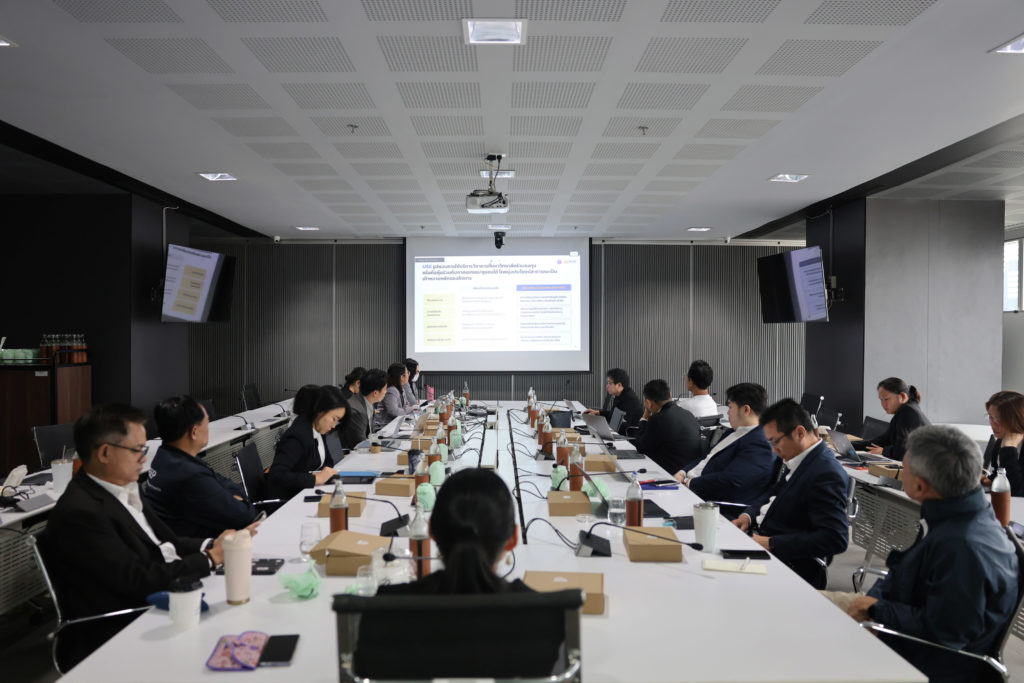
On 21 September 2026, NXPO held a consultation meeting on the “Guidelines and Regulatory Improvements to Promote University Social Enterprise (USE).” Representatives from higher education institutions and relevant agencies convened to exchange views and jointly develop policy directions and support mechanisms that will enable universities to apply knowledge, research, technology, and innovation to address social challenges and create positive impact.

Dr. Siriporn Pittayasophon, Vice President of NXPO, delivered the opening remarks, emphasizing that universities play an important role in national development and already have core missions in academic services and serving society. As social enterprises are established with the objective of generating social benefits, NXPO intends to promote this model as an option for universities to operate businesses that serve social purposes by removing regulatory constraints and developing an ecosystem and enabling environment that support the establishment and operation of University Social Enterprises (USEs). As an initial step, NXPO worked with King Mongkut’s University of Technology Thonburi (KMUTT) to develop guidelines for establishing university social enterprises. NXPO also worked with Chulalongkorn University to develop guidelines for improving regulations to promote the role of USEs. These guidelines were presented for feedback from university representatives and relevant experts at the meeting.

“NXPO has previously promoted the University Holding Company (UHC) mechanism as a model for universities to enhance research commercialization. Similarly, NXPO is now introducing the USE model to enable universities to pursue both commercial and social objectives, with greater emphasis on social impact. The feedback from this meeting will provide important input for improving the guidelines and developing relevant policy recommendations. This will help establish a support system for USEs that is appropriate to the context of Thai universities and enable universities to further apply knowledge and innovation to create greater impact for the economy, society, and communities,” Dr. Siriporn said.
Ms. Sirinporn Daengphuang, Policy Specialist at NXPO, presented the background and significance of the initiative, noting that USEs have the potential to create impact at the global level. According to The State of Social Enterprise: A Review of Global Data 2024, there are more than 10 million social enterprises worldwide, employing approximately 200 million people and generating combined annual revenues of up to USD 2 trillion, surpassing the global fashion industry. In Thailand, social enterprises can help address a range of national challenges, including employment opportunities for people with disabilities, care for a growing elderly population, food security, poverty reduction, and issues involving children and young people who have dropped out of the education system. In the United Kingdom, a Community Interest Company (CIC) was created as a special type of legal entity with an “asset lock” requiring most profits to be reinvested for social benefit. This encourages universities and researchers to establish social enterprises. As a result, 131 social enterprises have been established by more than 40 universities in the United Kingdom.

“University Social Enterprise is a strategy for enhancing the sustainability and flexibility of universities while addressing some of the challenges associated with traditional academic services. USE provides a model through which universities can co-invest or hold shares with private-sector partners or communities, with public benefit as the primary objective of the enterprise. It can provide universities with a revenue stream beyond government funding to support projects and services over the long term. As a social enterprise is established as a legal entity, it can also be managed according to business principles, providing greater flexibility in its operations,” Ms. Sirinporn said.

Asst. Prof. Dr. Santi Charoenpornpattana, Vice President for Planning and Strategy at KMUTT and Head of the project to develop guidelines for establishing University Social Enterprises (USEs), explained that KMUTT, in collaboration with NXPO, studied the requirements for establishing a USE and identified the areas in which universities need to prepare. The project defines a USE as an enterprise established, owned, or co-invested in by a university to apply the university’s knowledge, research outputs, technology, innovation, and resources to address social problems and respond to societal needs, while creating tangible and sustainable social impact. The guidelines provide a readiness assessment framework covering four areas: Clarity of Social Mission, Viable Business Model, University Ecosystem, and Policy Support and Institutional Legitimacy. These criteria are used to classify a university’s readiness into three levels:
- Initial Stage — The university has begun social enterprise activities but lacks clarity in terms of its business model and management structure. At this stage, activities may initially be operated as academic services.
- Transition Stage — The university is in the process of validating its business concept and focusing on generating partially self-sustaining revenue. At this stage, the university can develop a business plan and revenue-generation model.
- Full-Scale Operation — The university is ready in terms of governance, business planning, and social impact and is prepared to operate as a full-fledged social enterprise.
To promote USEs, universities should develop an ecosystem across six areas:
- Strategic Direction and Leadership — USE should be incorporated into the university’s strategic plan, with a senior executive, such as a vice president, appointed and assigned responsibility for driving USE development.
- Legal and Investment Structure — Universities should establish an appropriate legal structure for investment and co-investment based on their own context, taking into consideration all relevant factors as well as the university’s maturity in investing in innovation businesses.
- Governance — The university’s social mission must not be compromised by business success or profits. At the same time, the business must generate sufficient profits to ensure that its social mission can be sustained.
- Support Units and Infrastructure — Universities should establish a USE incubator and make university infrastructure available as a shared platform so that knowledge and innovation can be effectively developed into social enterprises. Support should be targeted and include a transition from subsidized support toward self-sufficiency.
- Financial Support Policies — Universities should establish mechanisms for seed funding as well as policies to help create markets and enable USEs to grow.
- Universities as Platforms for USEs — Universities should serve as platforms that enable USEs to access external support systems and networks.
Universities may establish a University Social Enterprise HR Sandbox that enables faculty members to work with USEs. This could be accompanied by arrangements allowing faculty members to retain their status as university employees and continue receiving their regular salaries and benefits, while counting their work with USEs toward their teaching and research workloads according to agreed proportions. Outputs from USE activities could also potentially be incorporated into applications for academic positions, with assessments taking into account multiple dimensions, including academic achievement, business and industrial success, and social impact.

Asst. Prof. Dr. Poomsiri Dumrongvute of the Faculty of Law, Chulalongkorn University, presented the draft guidelines for improving regulations to promote University Social Enterprise (USE). The presentation covered relevant laws and regulations concerning USEs, including the qualifications required for social enterprises and the benefits associated with social enterprise status. It also covered case studies on social enterprise fundraising, as well as key areas that universities need to review before establishing or co-investing in a USE. These include the legal status of universities; their authority to establish or invest in joint-venture companies; guidelines governing university personnel working in joint ventures; the commercial use of university assets; procurement and the use of university intellectual property; and the governance framework for USEs, among other issues.
The meeting provided a valuable exchange of views and a wide range of recommendations for further refining the handbook and policy guidelines. Participants agreed that this initiative could significantly encourage universities to strengthen their role in academic services, contribute to addressing national challenges, and create greater benefits for society. Participants also expressed the view that the knowledge and approaches presented at the meeting should be shared more widely with faculty members and universities already working in this area. The meeting also emphasized that establishing a USE requires a clear social objective, as well as personnel who are motivated to work toward social goals. Participants identified several key factors that could help drive the development of USEs, including financial instruments, key agents to lead the process, and the establishment of a USE Consortium to create a learning space and facilitate the sharing of experiences and successful practices. Participants also suggested that the USE establishment handbook should address the mindset and skills required of personnel working in this area.
The outcomes of the consultation process will be incorporated into the development of policy guidelines and measures needed to unlock regulatory constraints and support the operation of USEs, with the aim of developing models that can be scaled up nationwide.