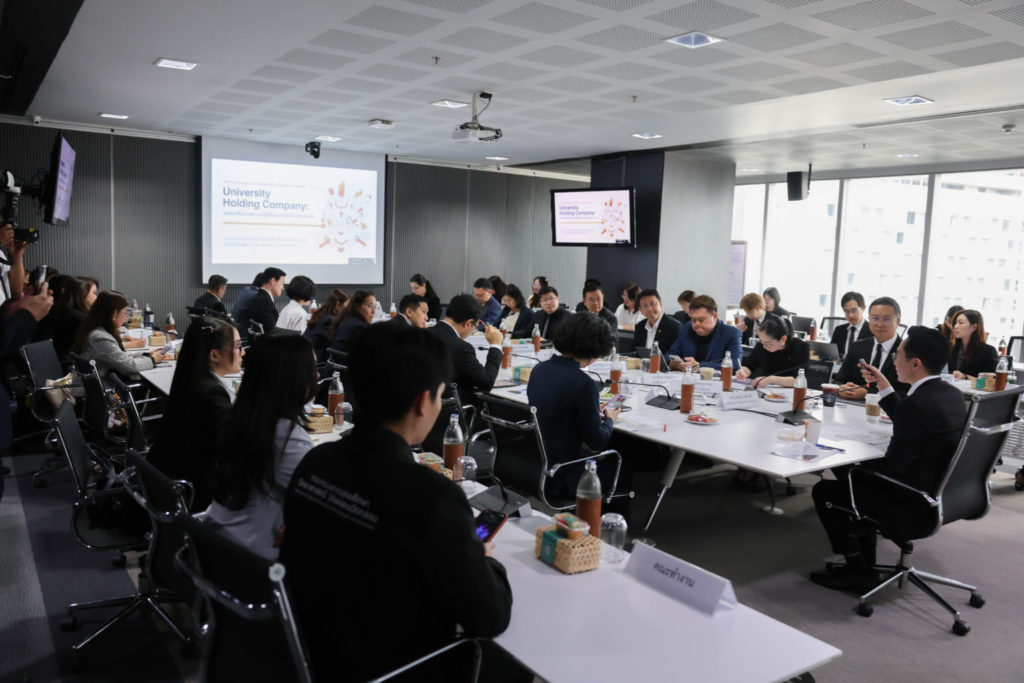
On 17 July 2026, NXPO convened a meeting to advance innovation-driven businesses through the University Holding Company (UHC) mechanism. The meeting was chaired by Prof. Dr. Yodchanan Wongsawat, Deputy Prime Minister and Minister of Higher Education, Science, Research and Innovation (MHESI), and brought together representatives from government agencies, universities, and the private sector.

In his opening remarks, Minister Yodchanan emphasized that Thai universities must evolve beyond generating knowledge to become engines of the country’s new economy. He stressed that UHCs should not be regarded simply as university-owned companies, but as a National Innovation Commercialization Platform that transform research into innovation-driven enterprises. By 2030, Thailand aims to build an innovation ecosystem that supports university spin-offs, deep-tech startups, intellectual property (IP) commercialization, strategic investment, and global partnerships.
Under this vision, UHCs will perform seven strategic functions: IP Holding, Startup Builder, Deep Tech Commercialization, Venture Builder, National Investment Platform, Industry Platform, and Global Expansion. Minister Yodchanan also identified seven priority sectors for investment: high-value agriculture and food, future mobility, smart electronics and digital technologies, medical and healthcare industries, high-value tourism, trade, and the creative economy.
He underscored the government’s role in creating an enabling environment for university entrepreneurship through regulatory reform, greater flexibility for university investment and equity ownership, standardized IP valuation, tax incentives for private investors, professional development for technology transfer and venture capital specialists, stronger linkages between research and public procurement, and the establishment of regulatory sandboxes.
Minister Yodchanan also unveiled the 2026–2030 UHC Roadmap, beginning with the establishment of UHCs in universities with strong potential, followed by expanding the pipeline of university spin-offs, strengthening investor networks, increasing private venture capital participation, and developing an ecosystem capable of producing globally competitive technology companies.

“The success of 21st-century universities should be measured by their ability to create technology companies, foster new industries, and strengthen national competitiveness. University Holding Companies are the bridge that transforms knowledge into long-term economic prosperity for Thailand,” said Minister Yodchanan.

Dr. Surachai Sathitkunarat, President of NXPO, presented the progress of UHC implementation and outlined key policy recommendations. He noted that the UHC initiative was first introduced in 2014, with five universities establishing holding companies. However, the lack of a clear legal framework at the time created uncertainty regarding their operations. To address these challenges, NXPO developed the Prime Minister’s Office Regulation on Public-Private Investment in Projects Utilizing Research and Innovation B.E. 2566 (2023), which clarified rules and removed major regulatory barriers. As a result, Thailand now has 13 University Holding Companies with combined registered capital exceeding THB 500 million, supporting more than 110 companies. Universities have also revised their internal regulations to facilitate UHC operations.
Dr. Surachai identified four key challenges facing UHCs: (1) funding and investment mechanisms; (2) governance and business management capabilities; (3) ecosystem integration and support; and (4) the commercial readiness of research outputs. To address these challenges, NXPO proposed five policy priorities:
- Develop flexible investment mechanisms for deep-tech ventures that align with technology commercialization pathways.
- Professionalize UHC management through dedicated expertise in investment, finance, business development, and intellectual property management.
- Strengthen the innovation ecosystem by connecting UHCs with investors, industry, and government to improve access to capital, markets, and industrial value chains.
- Expand the research commercialization pipeline by identifying and nurturing commercially promising research from an early stage to increase the number of investment-ready technologies and university spin-offs.
- Revise regulations to remove governance constraints, particularly those affecting university executives serving on the boards of UHCs and joint venture companies.
Dr. Surachai also proposed establishing a UHC Consortium as a public-private co-investment platform for deep-tech ventures. The consortium would enable universities to share expertise, infrastructure, and investment opportunities while partnering with the private sector. Such collaboration would reduce duplication, strengthen investor confidence, and maximize national economic impact.


The meeting concluded with an active exchange of views among universities and relevant organizations. Participants unanimously supported the establishment of the UHC Consortium, while several universities shared lessons learned from establishing and operating their own UHCs. NXPO reaffirmed its commitment to coordinating funding agencies, industry, and universities to build a dynamic UHC ecosystem that enables universities to commercialize high-quality research and generate innovation-driven businesses with measurable national impact.






“We hope this initiative will create a new growth engine for Thailand, generate new career opportunities in deep technology, and make Thailand an attractive destination for talent and investment. Within the next two to three years, we expect to see more startups, greater foreign investment, and a stronger innovation ecosystem that supports Thailand’s transition to a high-income economy. Universities will play a pivotal role by evolving from educational institutions into startup incubators, fostering the country’s research and innovation ecosystem,” Minister Yodchanan concluded.