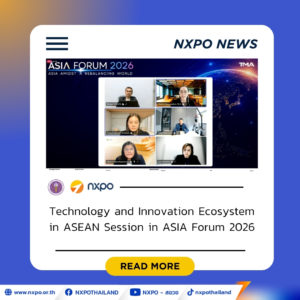
On 21 August 2026, Dr. Siriporn Pittayasophon, Vice President of NXPO, participated as a panelist in the session “Technology and Innovation Ecosystem in ASEAN” at ASIA Forum 2026, a virtual event hosted by the Thailand Management Association (TMA).

Dr. Siriporn discussed the rapidly evolving technology and innovation landscape across Asia, highlighting key areas including digital technologies and artificial intelligence (AI), semiconductors, biotechnology, and electric vehicles. At the same time, investment in research and development (R&D) across Asia has increased significantly, now accounting for approximately 45% of global R&D investment.
“Asia is no longer simply a technology importer. We are developing our own technologies, applying them in real-world settings, and bringing them to commercial markets. However, increasing R&D spending alone does not guarantee that a country will become an innovation leader,” Dr. Siriporn said.
She identified three key factors that will determine which countries emerge as future innovation leaders. First is strategic decision-making. Each country needs to identify areas where it has the greatest potential and determine which capabilities it must strengthen. Second is turning technology into an economic engine by translating research into commercial value. Third is building a strong and interconnected innovation ecosystem. Innovation today requires more than funding; it depends on skilled talent, investment, infrastructure, businesses capable of bringing ideas to market, and cross-border collaboration. Countries that can connect these elements and continuously adapt to a changing global landscape will be better positioned to gain a competitive advantage and emerge as innovation leaders.
On the prioritization of research, technology development, and workforce and capacity development, Dr. Siriporn noted that from a policy perspective, the key question is not simply how much a country invests, but how those investments are directed and how effectively they generate tangible impacts. In research, Thailand’s overall level of investment remains relatively modest compared with leading innovation-driven economies. Given limited resources, Thailand therefore needs to make strategic choices by focusing on areas where the country has existing strengths, areas with strong future demand, and areas where research can generate meaningful transformation. This means combining existing strengths with emerging technologies—for example, agriculture with biotechnology and digital technologies; manufacturing with AI and automation; and medical services with data and advanced medical technologies. Such integration can help upgrade established sectors while creating new economic opportunities.

In technology, Thailand has a strong manufacturing base, but much of its production still relies on technologies imported from abroad. The country therefore needs to make strategic decisions about which technologies should be developed domestically, which should be co-developed with international partners, and which should be imported. Another major challenge is moving technologies from the laboratory into real-world applications. This requires support across the entire innovation pathway, from research and development to commercialization and scale-up.
In terms of human resources, Thailand faces a mismatch between graduates’ skills and labor-market requirements. In fields experiencing shortages, particularly engineering and technical disciplines, the number of students entering these fields has not kept pace with employment demand. At the same time, challenges such as climate change, public health, food security, and an aging society cannot be addressed through a single discipline alone. Thailand therefore needs professionals who can work across disciplinary boundaries. Education and training systems must become more flexible, encompassing degree programs, short courses, work-integrated learning, post-master’s and postdoctoral programs in industry, and greater mobility of personnel between universities and the private sector. As technology continues to evolve, people must also continue to learn. Upskilling, reskilling, and lifelong learning must therefore be strengthened through closer collaboration among government, universities, and industry.
Dr. Siriporn also highlighted the importance of building a globally competitive technology and innovation ecosystem in Asia, emphasizing that one of the most urgent priorities is technology diffusion—ensuring that technologies reach a broader range of businesses, sectors, and members of the public. As technologies become more widely adopted, they can significantly improve productivity and generate greater value across the economy.
Asia already possesses many of the fundamental components needed to build a strong innovation ecosystem, including world-class universities and research institutions, innovative companies and startups, large markets, and rapidly growing technological capabilities. The challenge, however, is connecting these elements effectively. This requires collaboration across all sectors. Universities and research institutions need to work with industry and end users from the outset. Large companies can strengthen manufacturing capabilities while providing opportunities to test and scale up new technologies. Startups can introduce new innovations, while small and medium-sized enterprises (SMEs)—which constitute the majority of businesses across the region—represent another critical group. Widespread technology adoption among SMEs could have a significant impact on overall productivity. The government also has an important role in reducing risks and addressing gaps through measures such as supporting shared research and testing facilities, pilot projects, standards development, and appropriate regulatory frameworks. Investors and financial institutions can provide the capital needed to advance and scale technologies. Meanwhile, end users should be involved from the outset because they understand real-world needs and constraints and can help determine which solutions are practical.

“Regional cooperation is critically important. Countries across Asia have different areas of expertise. Some have strong research capabilities, while others have talent, capital, or large markets. Rather than trying to build everything within a single country, we can connect these capabilities across the region. Working together will enable Asia to achieve greater success than if each country were to work independently,” Dr. Siriporn concluded.