Over the past several years, Thailand has emerged as one of the region’s leading automotive manufacturing hubs and is now undergoing a full-scale transition toward electric vehicles (EVs).
Thailand has the potential to move beyond being a technology user by leveraging its strengths as ASEAN’s leading automotive manufacturing base, its well-established industrial base, engineering expertise, and robust domestic supply chain, together with government policies that promote investment and increase local content in manufacturing.
Although Thailand will continue to rely on certain upstream technologies from abroad in the short term, strategic investment, sustained support for research and development (R&D), and a strong innovation ecosystem will enable the country to develop its own technologies and create greater value in areas where it has competitive advantages.
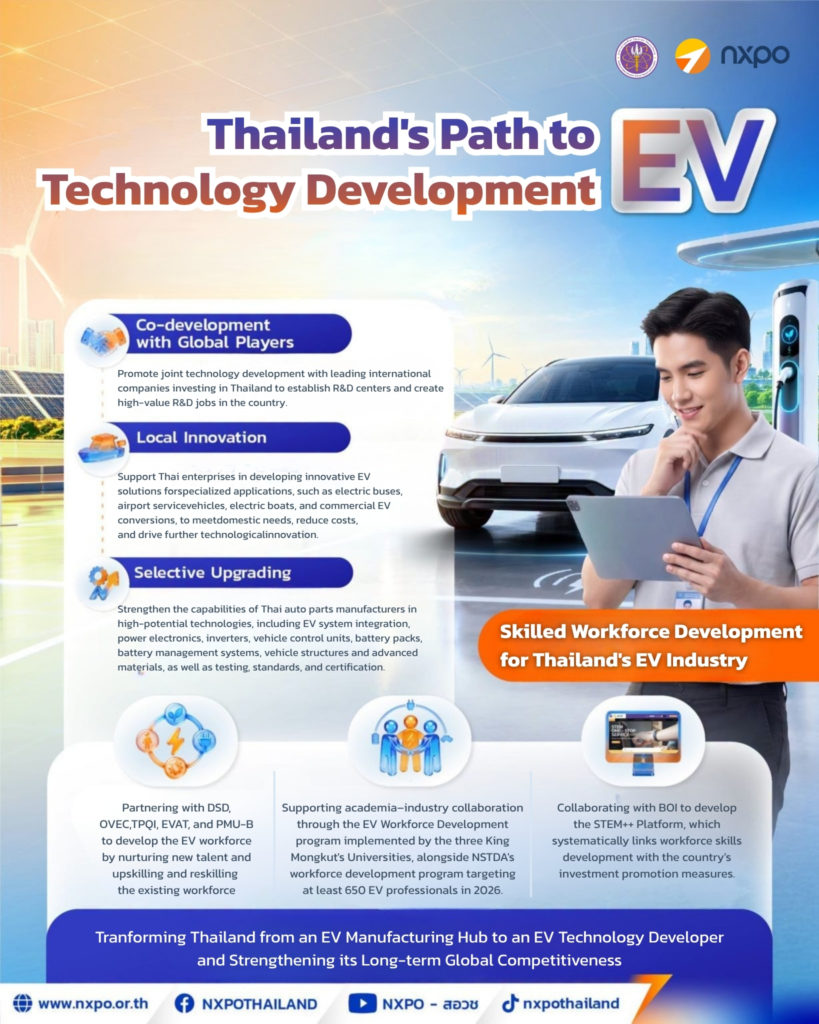
📌To support this transition from technology user to technology developer, NXPO has identified three strategic approaches:
- Co-development with Global Players
Promote joint technology development with leading international companies investing in Thailand, particularly EV and battery manufacturers. This includes encouraging the establishment of R&D centers and creating high-value R&D jobs in the country. Achieving this objective will require close collaboration among industry, universities, and government agencies.
- Local Innovation
Support Thai enterprises in developing innovative EV solutions tailored to specialized applications, such as electric buses, airport service vehicles, electric boats, and commercial EV conversions. These innovations address domestic market needs, reduce costs, and create opportunities for further technological advancement.
- Selective Upgrading
Strengthen the capabilities of Thai auto parts manufacturers by focusing on technologies where the country has strong competitive potential. Priority areas include EV system integration, power electronics, inverters, vehicle control units (VCUs), battery packs, battery management systems (BMS), vehicle structures and advanced materials, as well as testing systems, standards, and certification.
In addition to advancing technology, NXPO places strong emphasis on developing the skilled workforce needed to support Thailand’s growing EV industry.
NXPO has partnered with the Department of Skill Development (DSD), the Office of the Vocational Education Commission (OVEC), the Thailand Professional Qualification Institute (TPQI), the Electric Vehicle Association of Thailand (EVAT), and the Program Management Unit for Frontier Brainpower and Future Industries (PMU-B) to establish a collaboration agreement on EV workforce development. The initiative aims to bridge the gap between workforce skills and industry demand by developing new talent, upskilling and reskilling the existing workforce, and strengthening the capabilities of teachers, instructors, and industry personnel.
At the same time, NXPO supports collaboration between universities and industry through government-funded programs, particularly the targeted EV Workforce Development Program implemented by the three King Mongkut’s Universities. The program enables industry partners to participate in curriculum design and workforce training, ensuring that graduates possess the skills required by employers. NXPO also collaborates with research organizations such as the National Science and Technology Development Agency (NSTDA) to strengthen technology-oriented workforce development, with a target of developing at least 650 EV professionals in 2026.
Furthermore, NXPO is working with the Thailand Board of Investment (BOI) to develop the STEM++ Platform, which systematically links workforce skills development with the country’s investment promotion measures.
On the innovation front, NXPO serves as a bridge between the research community and industry to ensure that research outcomes can be translated into commercial applications. Its efforts include supporting collaborative R&D projects, strengthening testing and standards infrastructure, and fostering an innovation ecosystem that enables domestic technology development.
Thailand’s objective is not to compete across every segment of the EV industry. Rather, it is to invest strategically in areas where the country has the greatest potential, enabling it to evolve from a manufacturing base into an active contributor to EV technology development while strengthening its long-term global competitiveness. At the same time, the initiative seeks to attract domestic and international experts and forge long-term collaborative partnerships that accelerate knowledge transfer and enhance the capabilities of the Thai workforce.
NXPO is committed to serving as a strategic connector among universities, industry, and government agencies, ensuring that EV workforce development and innovation are aligned with industry needs and effectively translated into nationwide implementation.