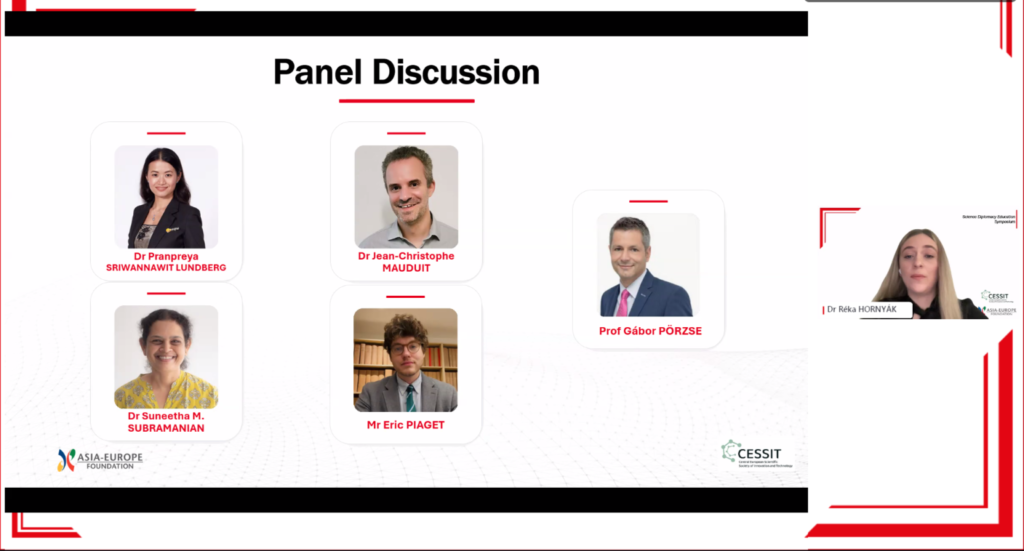
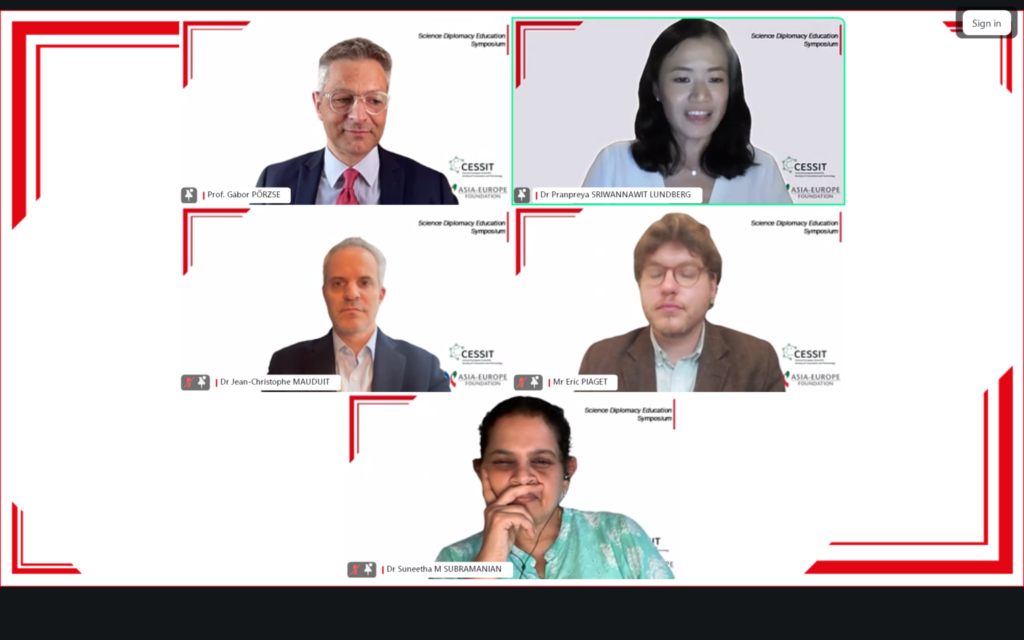
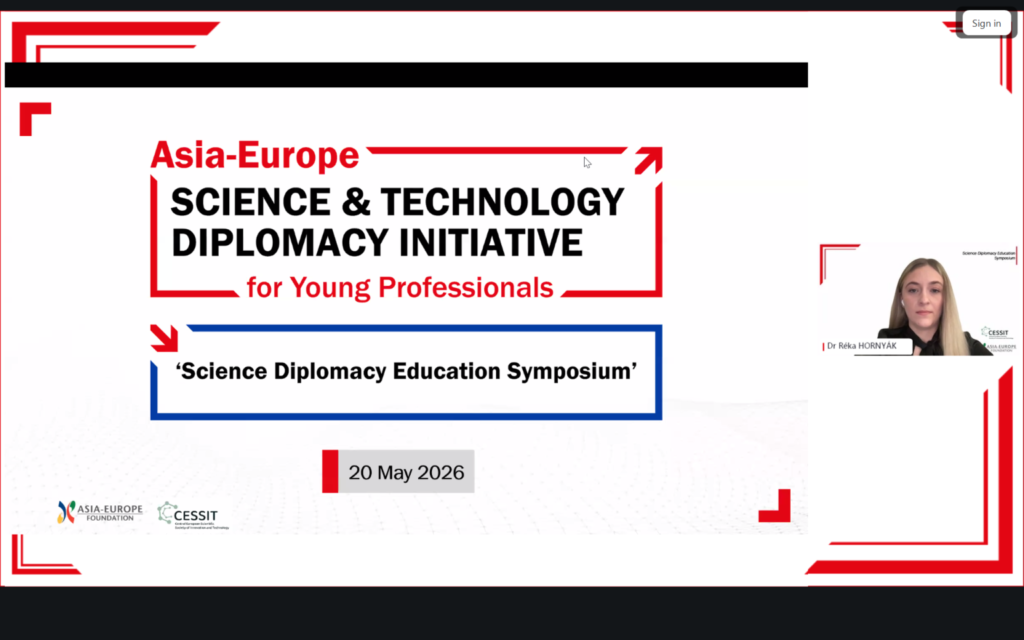
On 20 May 2026, Dr. Pranpreya Sriwannawit Lundberg, Senior Director of International Policy Partnership at NXPO, delivered a presentation at the Science Diplomacy Education Symposium, jointly organized by the Central European Scientific Society of Innovation and Technology (CESSIT) and the Asia-Europe Foundation (ASEF). The symposium sought to raise awareness of science and technology diplomacy as an increasingly important field in both education and policymaking, while highlighting its role in strengthening Asia–Europe cooperation. The event also provided a platform to explore approaches for integrating science diplomacy into higher education and underscored the role of universities as key actors in advancing international collaboration, knowledge exchange, and stronger connections between science and policy.
During her presentation, Dr. Pranpreya shared perspectives on science diplomacy, particularly in the context of higher education and academia. She noted that Thailand has positioned higher education, science, research, and innovation as strategic pillars for enhancing national competitiveness and preparing the country for future challenges. This direction is reflected in two key national frameworks: the National Science, Research and Innovation Plan and the Higher Education Plan (2023–2027). Both are aligned with Thailand’s 20-Year National Strategy and the 13th National Economic and Social Development Plan and are designed to accelerate the country’s development through coordinated action across sectors.
Dr. Pranpreya also emphasized the action-oriented nature of these plans, which focus on high-priority areas where Thailand possesses geopolitical or cultural strengths. Higher education institutions play a central role in advancing these priorities. Thailand’s higher education policy has been strategically designed to transform universities into innovation hubs through national initiatives such as the Reinventing University Program, which supports institutions in achieving international standards and fostering research ecosystems.
“For science diplomacy to achieve meaningful impact, coordination among various agencies is essential. The Ministry of Higher Education, Science, Research and Innovation (MHESI) serves as the lead implementing agency for higher education and innovation, while NXPO plays a policy and strategic role as the secretariat to the National Higher Education, Science, Research and Innovation Policy Council. Another key partner is the Ministry of Foreign Affairs. We are working together under the ‘Team Thailand’ approach, whereby diplomacy and foreign affairs are supported by strong scientific capabilities and universities,” said Dr. Pranpreya.
She further highlighted universities as powerful drivers of science diplomacy due to their unique flexibility. Universities can contribute in three important ways. First, they support Track II diplomacy by providing safe and neutral spaces for dialogue, particularly during periods of geopolitical tension or economic uncertainty. Second, they cultivate talent and global networks through student exchanges, joint degree programs, and international research collaborations. Third, they serve as valuable sources of knowledge and evidence, providing diplomats with reliable information, technical expertise, and evidence-based insights needed for international negotiations on issues such as climate change and trade standards.
“In science diplomacy education, the role of higher education institutions extends beyond knowledge creation. Universities can also serve as platforms for collaboration, trust-building, and problem-solving. Moreover, if universities are to strengthen their global engagement, they must cultivate professionals who can operate effectively at the intersection of science, policy, and international affairs,” Dr. Pranpreya concluded.