Why a Science, Technology and Innovation Policy Compass?
Science, Technology and Innovation (STI) have become decisive forces shaping the economic, social, and security trajectories of countries worldwide. The Fourth Industrial Revolution has accelerated STI’s transformation from a supporting production tool into a central mechanism for enhancing competitiveness, addressing key societal challenges, and advancing the Sustainable Development Goals (SDGs).
Emerging technologies are increasingly converging the digital, physical, and biological domains. Notable examples include the application of artificial intelligence to accelerate synthetic biology research and expedite the development of mRNA vaccines for COVID-19, which shortened development timelines from several years to less than one year. Such breakthroughs are reshaping the global landscape at unprecedented speed and raising expectations for more agile and forward-looking public policymaking.
At the same time, the world faces increasingly complex and interconnected challenges—climate change, geopolitical tensions, technological competition, and vulnerabilities in global economic and supply chains. Countries are placing greater emphasis on technological security and national interests, resulting in more selective patterns of international cooperation in science and technology.
In this evolving context, STI policymaking can no longer rely on traditional approaches or simple policy imitation. Countries need robust tools and reliable data to understand global trends, assess risks, and design policies tailored to their own national contexts. Only then can STI effectively function as a driver of economic growth, social progress, and national security.
Global Trends in STI Policy
STI policy is shifting from broad-based investment aimed at enhancing general research capacity toward more targeted, mission-oriented approaches to address systemic challenges (Mission-Oriented Innovation Policy: MOIP), such as climate change, health, and economic security. This approach integrates both research support instruments and innovation market-shaping mechanisms. MOIP is widely regarded as a practical policy framework for achieving transformative agendas. Transformative agendas define the type of systemic change society seeks, while mission-oriented policies specify how governments and stakeholders coordinate, steer, and mobilize innovation efforts to deliver those systemic outcomes. In parallel, countries are increasingly prioritizing research security, strategic autonomy, and the development of dual-use technologies applicable to both civilian and military purposes. The closer linkage between STI and national security has reshaped international scientific collaboration, leading to more selective partnerships and stronger emphasis on technology risk management.
STIP Compass: A Key Tool for Policymaking
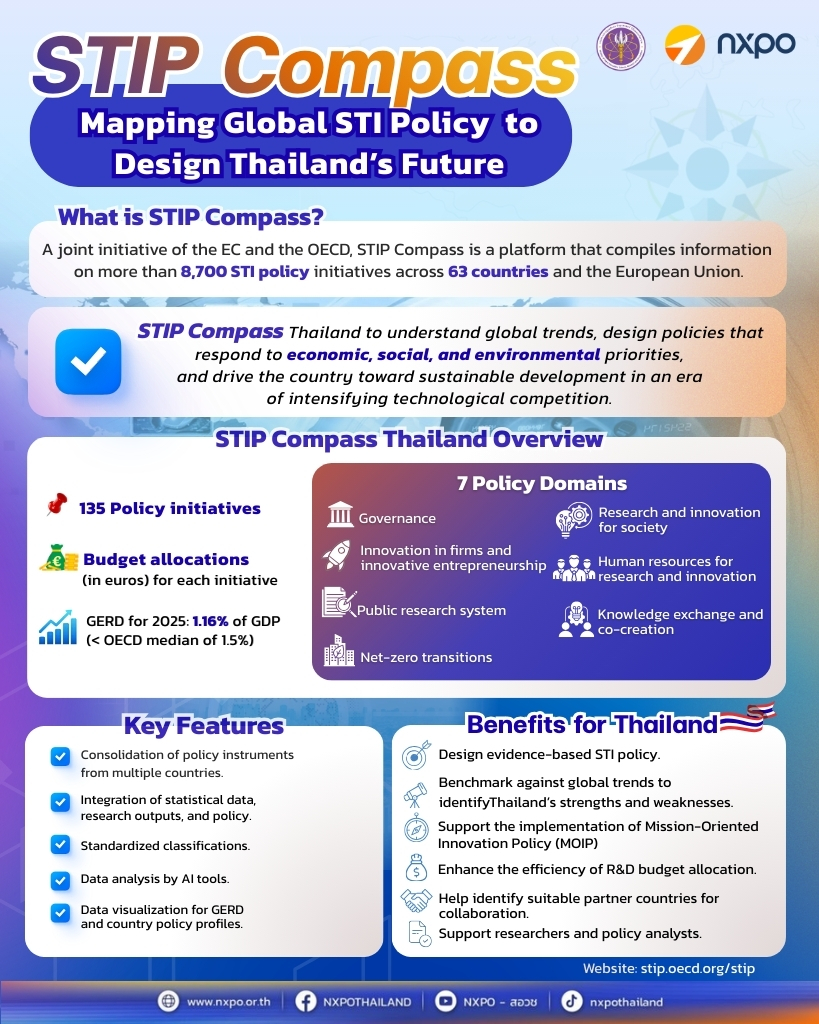
STIP Compass is a joint initiative of the European Commission (EC) and the Organisation for Economic Co-operation and Development (OECD). It consolidates STI policy data from countries around the world into a single, comprehensive platform.
The database compiles information on more than 8,700 policy initiatives across 63 countries and the European Union, supporting trend analysis and evidence-based policy design. The platform is freely accessible at: https://stip.oecd.org/stip/
Key features of the platform include:
- Consolidation of policy instruments from multiple countries within a unified system
- Integration of statistical data, research outputs, and policy information
- Application of standardized classifications to enable cross-country comparison
- Support for evidence-based policymaking
- Use of AI technologies to assist in data collection and analysis
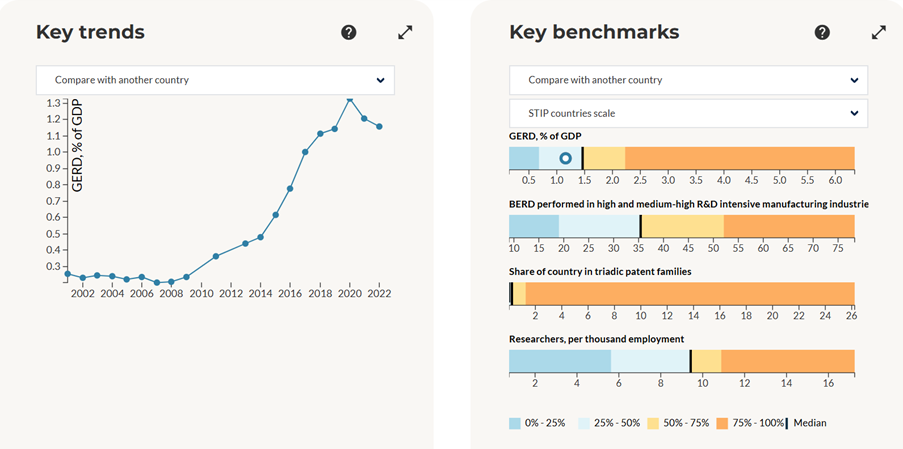
Data visualization of Thailand’s Gross Expenditure on R&D (GERD) in STIP Compass, illustrating the growth trend (left) and comparing the latest value—1.16% of GDP—with the OECD median of 1.5% of GDP (right).
Applications of STIP Compass
STIP Compass can be applied in mutiple ways:
- Policy formulation support – Enables analysis of global trends and the design of policies aligned with national contexts.
- International benchmarking – Facilitates learning from successful policy approaches, avoiding common pitfalls, and identifying priority areas for international collaboration.
- Research and policy analysis support – Provides systematic, accessible data for academics and policy analysts in user-friendly formats.
- Enhancing STI investment efficiency – Assists governments in planning and allocating resources more strategically.
- Policy alignment and integration – Supports the positioning, direction-setting, monitoring, and coherence with MOIP and broader transformative agendas.
STIP Compass Thailand Overview
Thailand has undertaken continuous reform of its STI system, including the establishment of the Ministry of Higher Education, Science, Research and Innovation (MHESI) and the development of strategic governance mechanisms integrating policy, budgeting, and monitoring and evaluation.
Thailand’s core policies aim to leverage STI to strengthen an innovation-driven economy, enhance national competitiveness, reduce social inequality, and promote sustainable development. The country also emphasizes technology transfer, innovative entrepreneurship, and human capital development in STI, while advancing the Bio-Circular-Green (BCG) Economy model and greenhouse gas emission reduction targets.
Thailand has 135 policy initiatives recorded in the STIP Compass database. The STIP Compass Thailand Overview Report presents budget allocations (in euros) for each initiative and categorizes them into seven policy domains: Governance; Public Research System; Innovation in Firms and Innovative Entrepreneurship; Knowledge Exchange and Co-creation; Human Resources for Research and Innovation; Research and Innovation for Society; and Net Zero Transitions. The report is designed for government officials, policy analysts, and academics seeking information and analytical insights on STI policy landscape.
In today’s rapidly changing and uncertain world, STI policy plays a critical role in shaping the country’s future trajectory. Tools that enable policymakers to understand global developments and support informed decision-making are essential to ensuring that science, technology, and innovation serve as powerful drivers of sustainable economic, social, and environmental development. STIP Compass therefore functions as a “policy compass,” guiding strategic direction and enabling effective responses to national development challenges in the modern era.
The STIP Compass Thailand Overview is available at: https://stip.oecd.org/stip/interactive-dashboards/countries/Thailand
The STIP Compass platform can be accessed at: https://stip.oecd.org/stip/