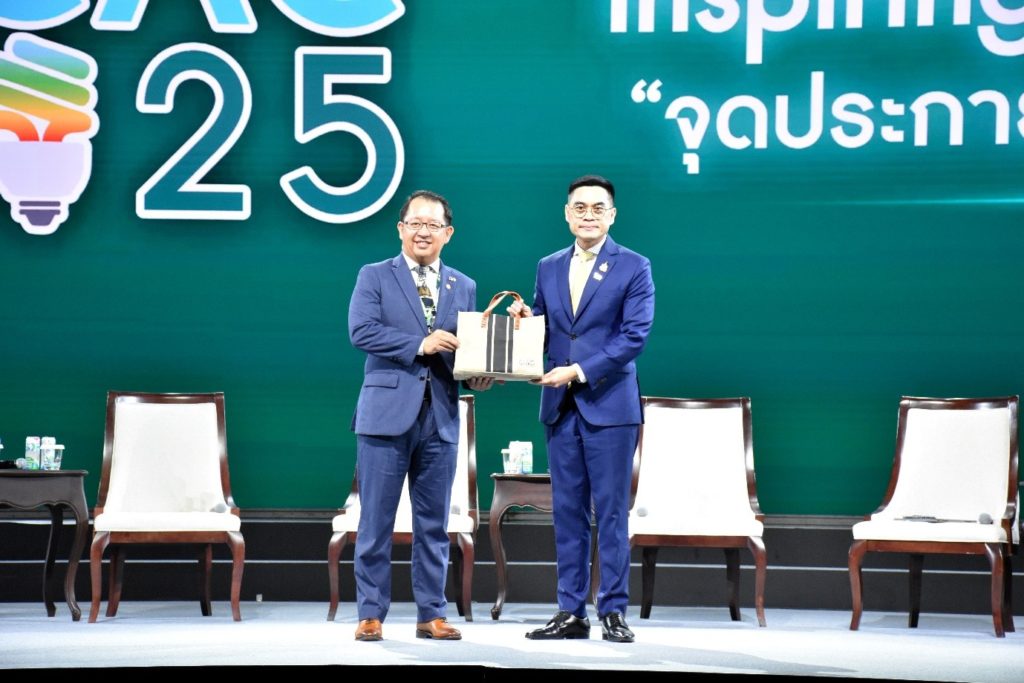
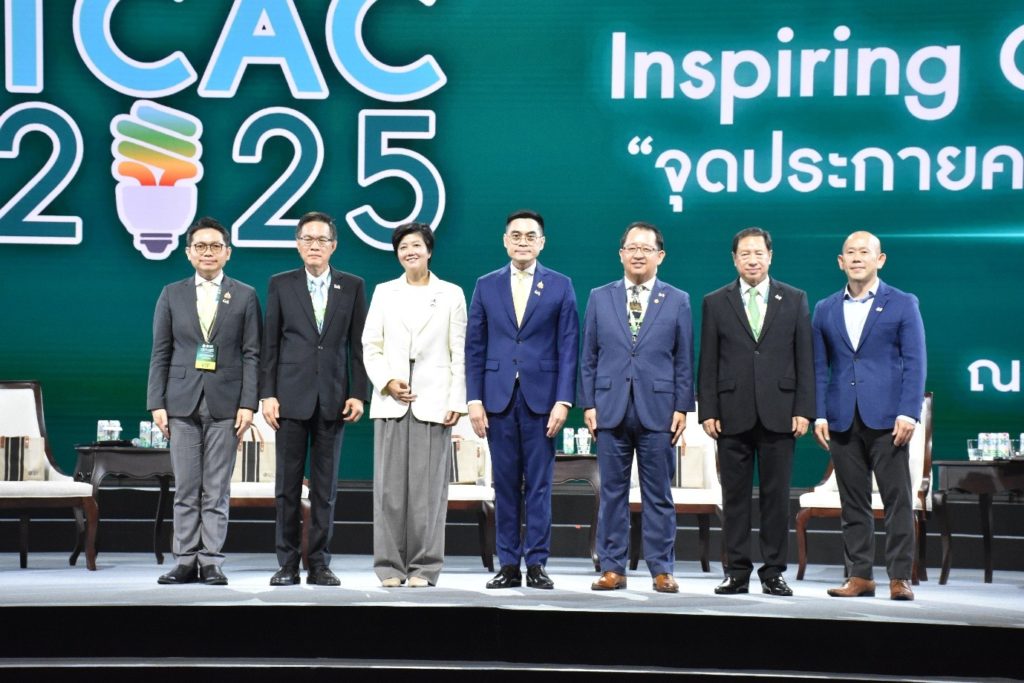
Assoc. Prof. Wongkot Wongsapai, Vice President of NXPO, participated in the Thailand Climate Action Conference (TCAC 2025) held under the theme “Inspiring Climate Solutions for All” on 30 September 2025. He joined a panel discussion on “Technology Transition,” alongside distinguished speakers from PTT Exploration and Production (PTTEP), the Federation of Thai Industries (FTI), the Board of Investment (BOI), the World Bank, and the Department of Climate Change and Environment (DCCE).
Assoc. Prof. Wongkot highlighted the growing importance of green jobs and green skills, which are increasingly sought after in the global labor market. These roles are critical in driving transformation across industries—including manufacturing, commercial buildings, logistics, and agriculture—toward achieving organizational net-zero goals.
To foster the development of a green-skilled workforce, NXPO, in collaboration with the National Science and Technology Development Agency (NSTDA), has developed a Green Skills Framework comprising three levels:
- Basic Skills: attitudes and soft skills such as storytelling.
- Cross-Sectional Skills: essential competencies for organizational advancement such as future thinking.
- Sector-Specific Skills: specialized skills for areas such as future mobility and biofuel technology.
The study also identified eight key competencies essential for the current and future workforce: (1) System Thinking, (2) Future Thinking, (3) Design Thinking, (4) Circular Thinking, (5) Digital Skills, (6) Sustainability Thinking, (7) Change Management Skills, and (8) Multidisciplinary Thinking.
In higher education, several Thai universities are planning to include skill profiles in student transcripts, in addition to traditional grades and coursework, to help employers better understand graduates’ capabilities and expertise, thereby facilitating more effective job matching.
For non-formal education, upskilling and reskilling programs are essential to ensure continuous workforce development aligned with the needs of the modern labor market. NXPO has launched the STEMPlus Platform, which allows businesses and universities to register STEM-related courses eligible for corporate tax deductions. Further details are available at https://www.nxpo.or.th/th/12169/ NXPO reaffirms its strong commitment to supporting Thailand’s transition toward net zero greenhouse gas emissions, with the national target expected to be accelerated from 2065 to 2050. This ambition will be pursued through continuous policy development and initiatives in higher education, science, research, and innovation to effectively address the challenges of climate change.