On 27 March 2026, NXPO, in collaboration with the Organisation for Economic Co-operation and Development (OECD), held the “OECD-Thailand Seminar: STI Outlook 2025 & STIP Compass” via an online platform.

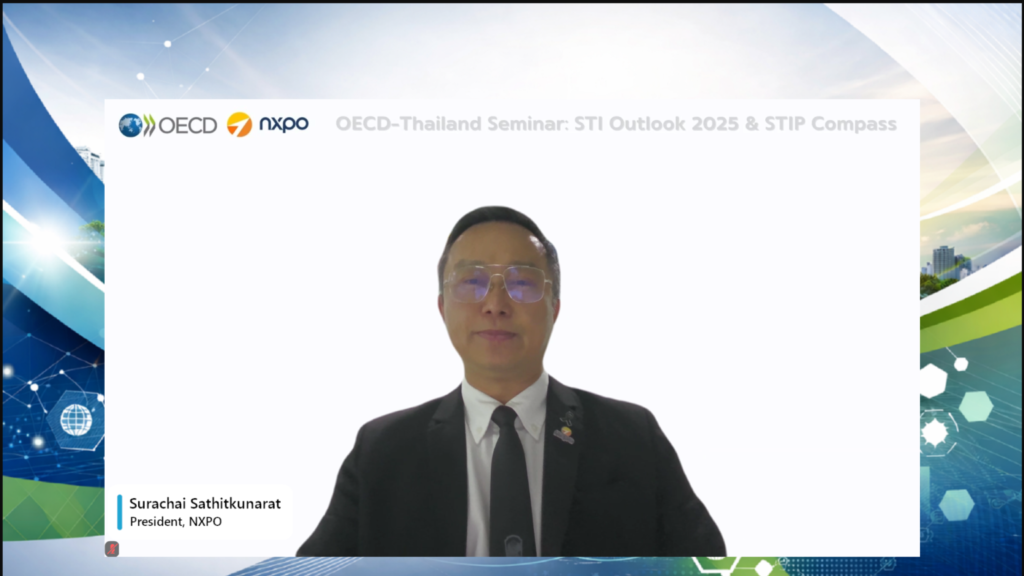
In his opening remarks, Dr. Surachai Sathitkunarat, President of NXPO, noted that the seminar was convened at a critical time when the world is undergoing rapid transformations, including technological convergence and increasing geopolitical volatility. These developments are reshaping global economic structures as well as national science, technology and innovation (STI) systems, including that of Thailand, which must prepare to respond to emerging opportunities and challenges.
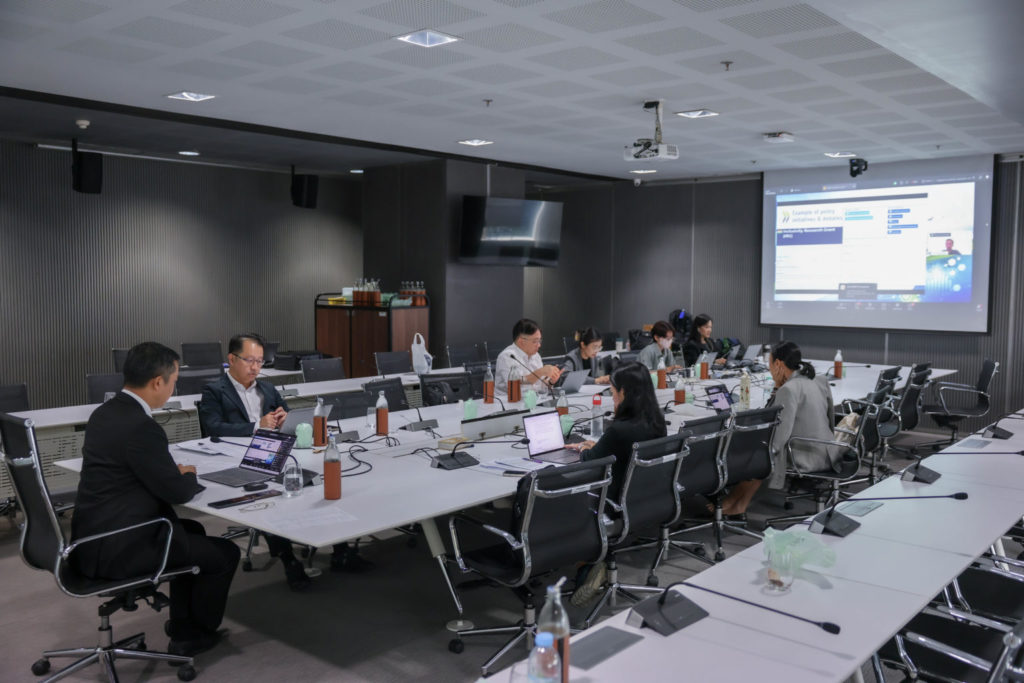
The OECD Science, Technology and Innovation Outlook 2025 highlights evolving global innovation trends and emphasizes that science systems must adapt to drive sustainable transformation. At the same time, governments need more agile and precise policy responses to emerging technologies—such as artificial intelligence (AI) and advanced materials—to maintain national competitiveness.
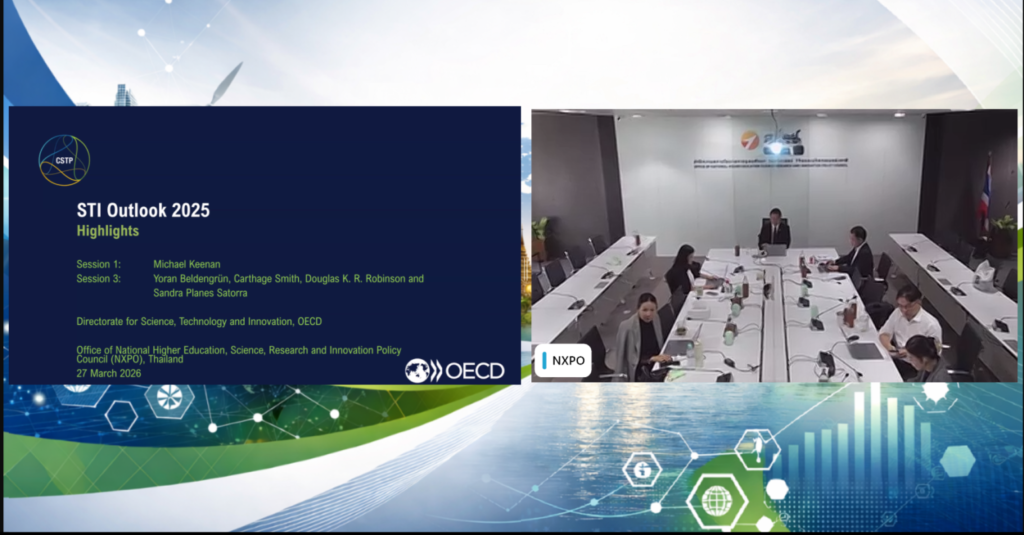
Thailand has also been actively utilizing STIP Compass, an international platform that compiles STI policy information from countries worldwide. Currently, 135 of Thailand’s policy initiatives are recorded on the platform. Ongoing updates ensure that the database remains current and accurately reflects the country’s development direction, while also inviting contributions from all sectors to propose additional policy initiatives.
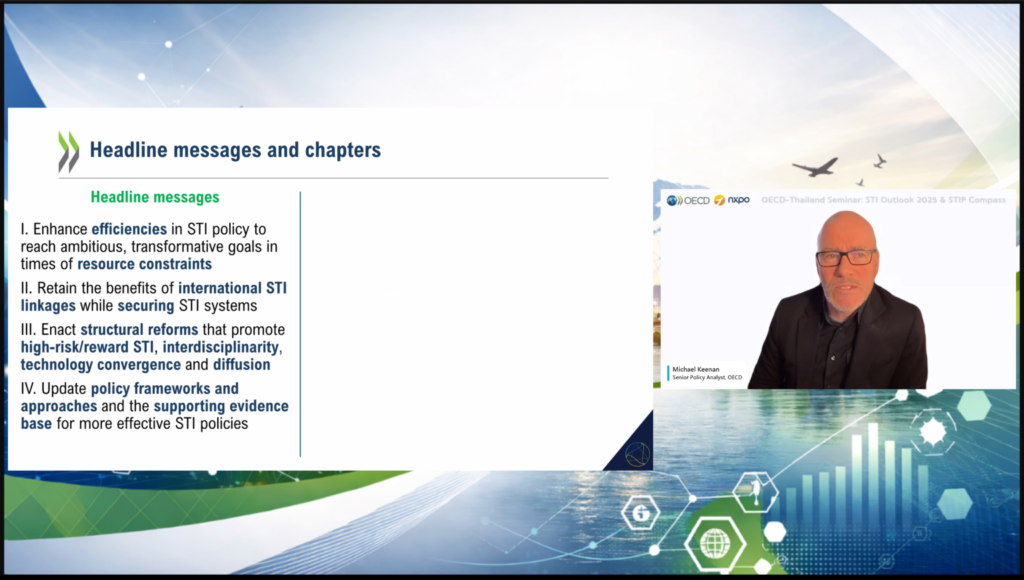
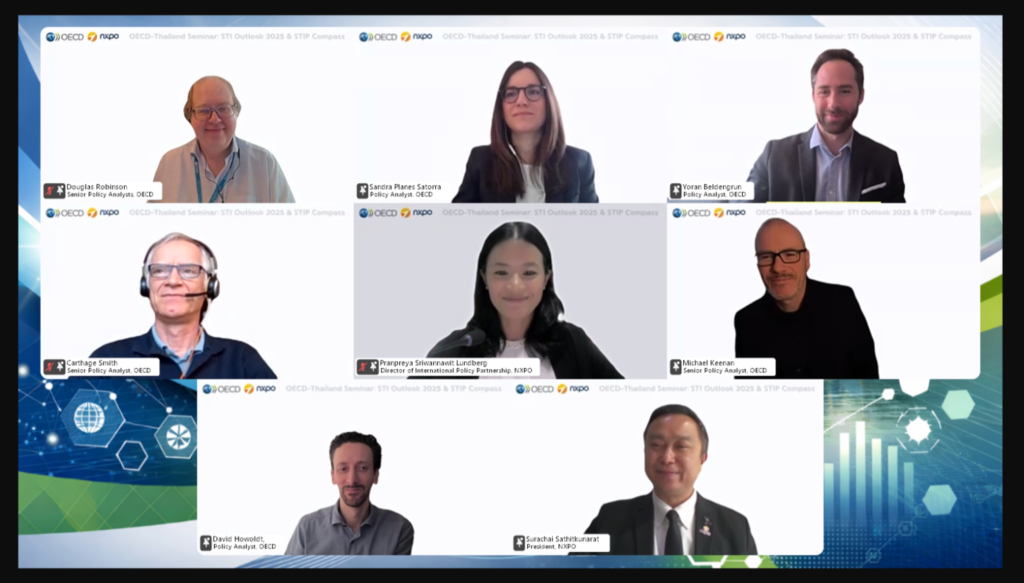
The seminar was moderated by Dr. Pranpreya Sriwannawit Lundberg, Director of International Policy Partnership at NXPO. The first session provided an overview of STI Outlook 2025, delivered by Michael Keenan, Senior Policy Analyst at the OECD. He outlined key drivers shaping both challenges and opportunities for STI policy, including: 1) Global challenges amid fiscal constraints such as population ageing and climate change; 2) Geoeconomic tensions and concerns over economic security, which are reshaping innovation networks and international research collaboration; 3) Inequality of opportunity and growing social fragmentation, which are eroding public trust in science, exacerbating disparities, and hindering necessary structural transformation; and 4) Emergence and convergence of transformative technologies—particularly AI— which not only result from STI development but are also redefining the future direction of scientific research and innovation.
These trends suggest that STI policy is at a critical turning point. To ensure that STI systems remain responsive and keep pace with rapidly changing environments, structural reforms are needed to enhance the efficiency and effectiveness of public policy implementation. Strengthened national innovation systems will be essential as key mechanisms for driving transformation in line with evolving policy contexts and for building resilience against future challenges.
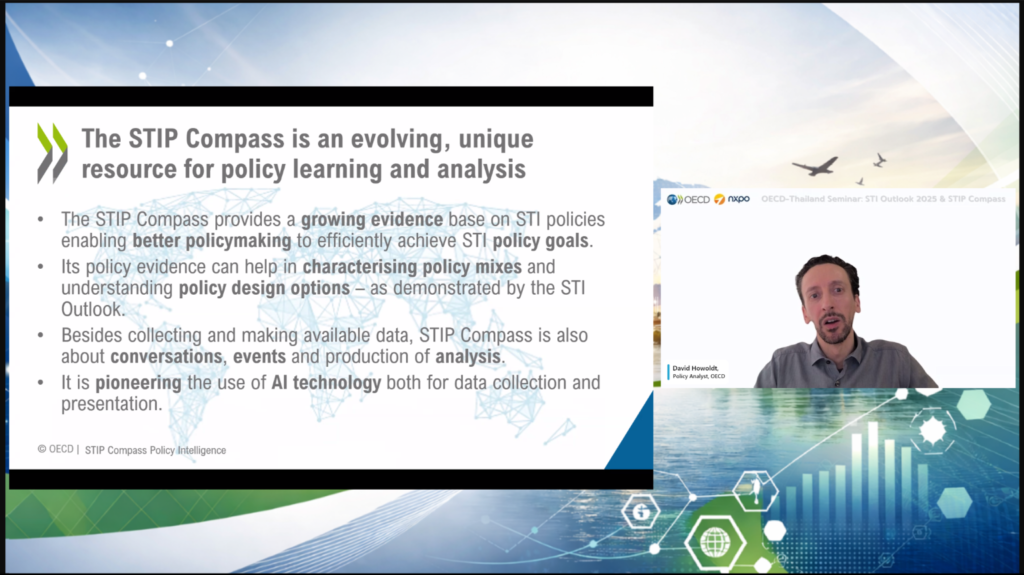
The session on STIP Compass, presented by David Howoldt, Policy Analyst at the OECD, introduced the platform as a global repository consolidating STI policy information from across countries. The platform aims to expand the evidence base for policymaking, thereby improving policy design and effectiveness. In addition to functioning as a policy design database, STIP Compass serves as a space for knowledge exchange and analytical work. The platform also integrates AI technologies in both data management and the generation of more precise analytical outputs.
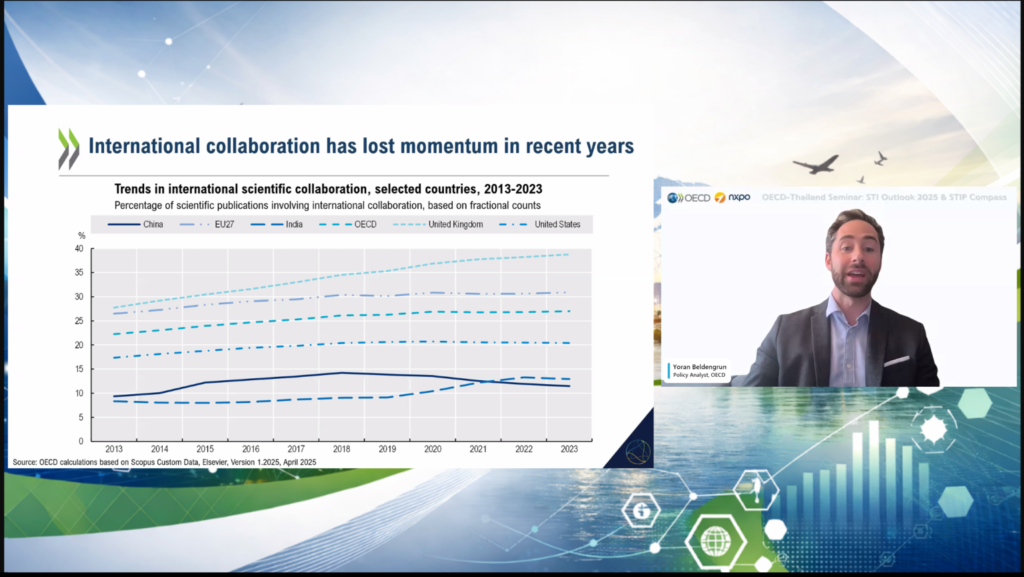
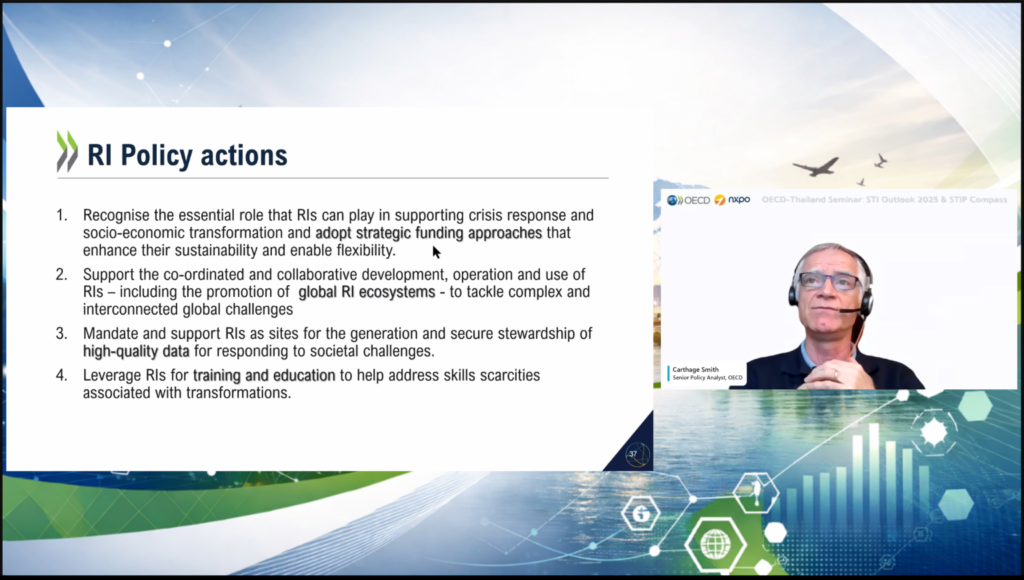
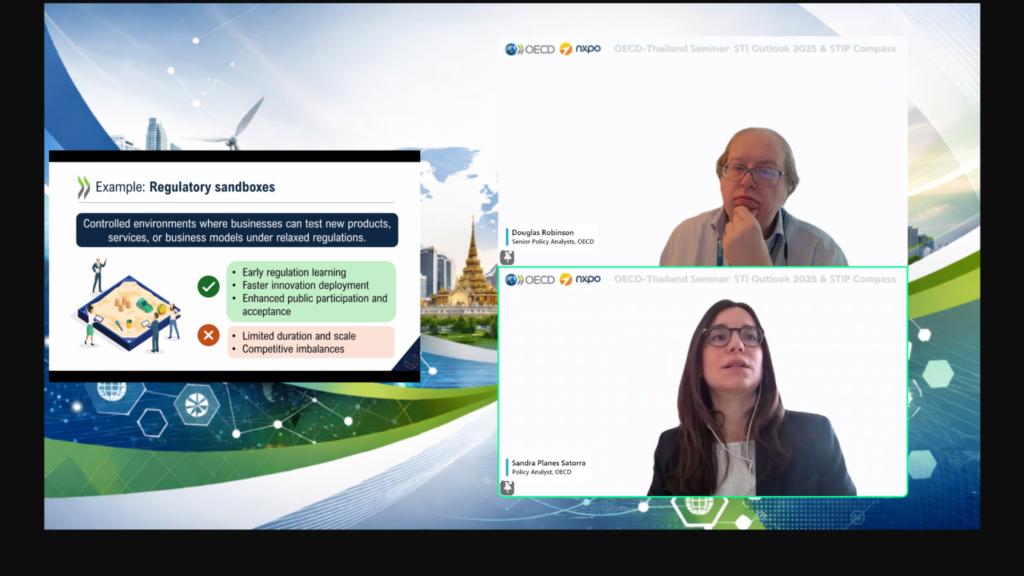
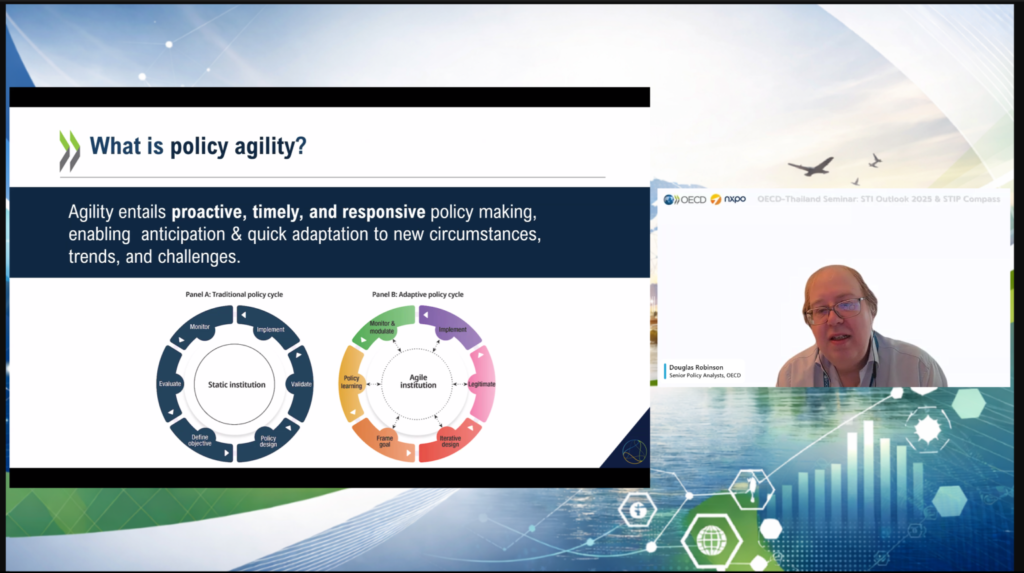
The session on “Deep Dive into STI Outlook 2025: Driving Change in a Shifting Landscape,” provided in-depth insights into selected chapters of the report. Presentations were delivered as follows:
- Chapter 2: Reconfiguring scientific co-operation in a changing geopolitical environment – presented by Yoran Beldengrun, Policy Analyst, OECD
- Chapter 4: How science systems need to adapt to support transformative change – presented by Carthage Smith, Senior Policy Analyst, OECD
- Chapter 5: Technology convergence: Trends, prospects and policies – presented by Douglas Robinson, Senior Policy Analyst, OECD
- Chapter 7: Tools for agility: Actionable strategic intelligence and policy experimentation – presented by Douglas Robinson, Senior Policy Analyst, and Sandra Planes Satorra, Policy Analyst, OECD

Further information and resources:
OECD Science, Technology and Innovation Outlook 2025:https://www.oecd.org/en/publications/2025/10/oecd-science-technology-and-innovation-outlook-2025_bae3698d.html
EC–OECD STIP Compass: https://stip.oecd.org/stip/https://stip.oecd.org/stip/
NXPO’s article on STIP Compass: https://www.nxpo.or.th/th/en/43539/