Initiated by NXPO, the STEMPlus platform serves as a key mechanism for strengthening Thailand’s workforce in science, technology, and innovation to support the country’s economic and technological transformation. The platform has continued to expand in terms of accredited courses, trained participants, and employment placements for high-skilled personnel—reflecting sustained efforts to align workforce capabilities with industry demand and national development priorities.
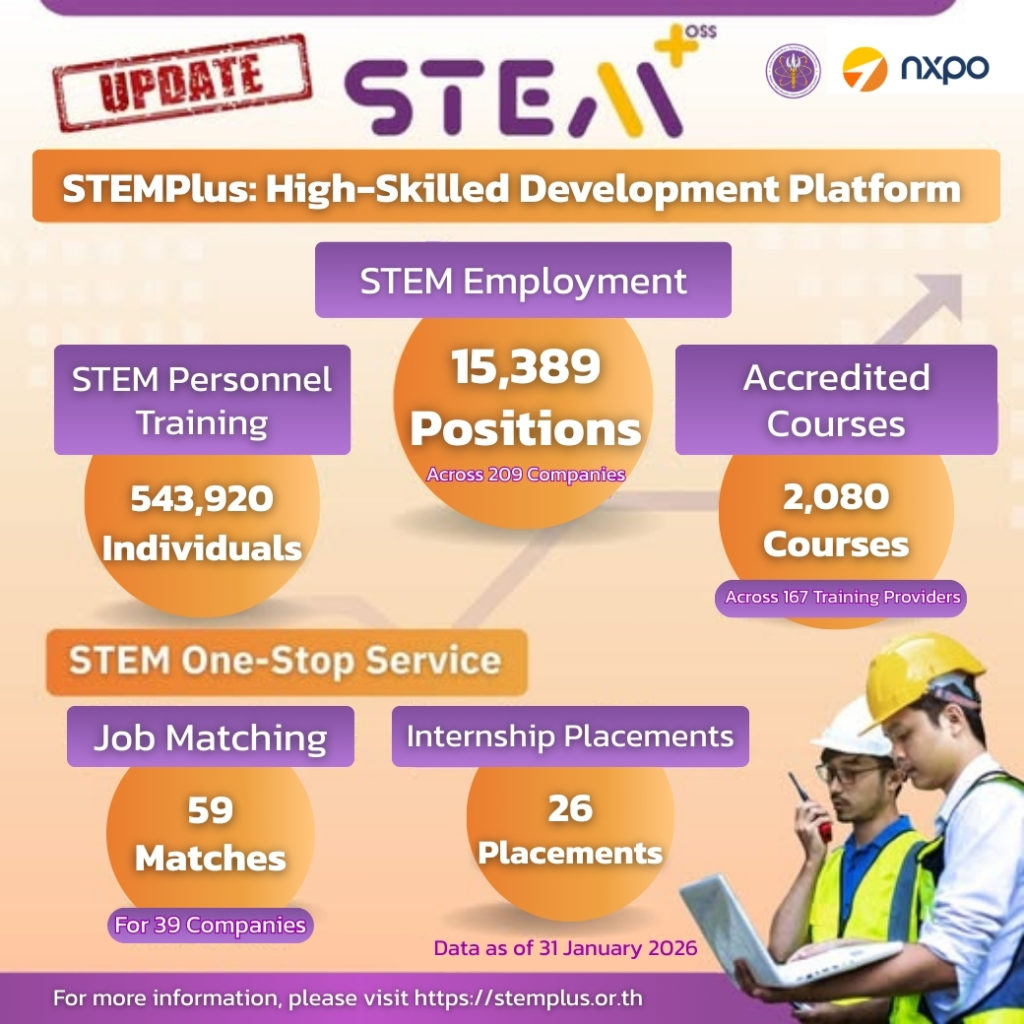
To date, 2,080 courses have been accredited across 167 training providers and educational institutions. A total of 543,920 individuals have completed training, and 15,389 STEM positions have been certified for employment across 209 companies. In 2025, an average of 70 courses per month were accredited, most of which support the digital industry, next-generation automotive industry, and smart electronics industry. This trend underscores the growing demand for high-skilled talent in Thailand’s target industries.
All courses accredited on the STEMPlus platform undergo a systematic quality assurance process. This includes alignment with the Future Skills Set framework, developed based on workforce demand surveys in target industries and encompassing both technical and general skills. Course evaluation also considers curriculum structure, outcome-based learning design, practical skill development, verifiable assessment systems, and the qualifications of instructors—who must possess professional expertise and direct industry experience. These measures ensure that accredited courses meet rigorous quality standards and effectively respond to labor market needs.
Courses that are particularly popular among the private sector are concentrated in digital and AI transformation—such as Generative AI for Business, ChatGPT for Executives, Microsoft 365 Copilot, AI Strategy, and Machine Learning with Python—as well as data and business intelligence, including Power BI & Data Visualization, Data Analytics & Business Intelligence, and Data Architecture for AI. There is also strong demand for courses in automation and digital workflow, cybersecurity, and sustainability and ESG, including carbon footprint programs. These trends reflect the increasing need for capabilities that support organizational digital transformation and the transition to a green economy.
The continuous expansion of accredited courses enables businesses to design more flexible and strategically aligned workforce development plans. Companies can select programs tailored to their specific needs while benefiting from tax incentives for employee training—helping to reduce costs and encourage sustained investment in skills development. Most courses are developed by the private sector and informed by workforce demand survey data, allowing for rapid and practical skill development that addresses real-world industry requirements.
The STEMPlus platform is also open to students and the general public, offering career pathways across ten target industries: next-generation automotive; smart electronics and robotics; high-value tourism and medical tourism; agriculture and biotechnology; food processing and future food; aviation and logistics; fuels, chemicals, and the green economy; creative industries; digital industries; and medical services. This comprehensive coverage enables learners to plan their skill development in line with career goals, enhance employability, and pursue sustainable career advancement.
In the next phase, NXPO aims to further enhance the platform’s quality by focusing on advanced skills that support technological and economic transformation. Priority areas include advanced digital skills—such as artificial intelligence, big data analytics, cybersecurity, and intelligent automation—alongside sustainability and green economy competencies, interdisciplinary capabilities, and essential behavioral skills such as systems thinking and complex problem-solving.
In addition, the STEM One-Stop Service (OSS) has been established to connect skilled personnel with businesses. To date, it has facilitated 59 job matches for 39 companies and supported 26 internship and cooperative education placements, contributing to workforce recruitment in advanced industries. The platform also collaborates closely with industry partners to co-develop curricula and deliver short-term training programs that address urgent labor market needs.
NXPO plans to expand STEMPlus into an integrated workforce intelligence platform, linking industry skill demand data with course offerings and learning outcomes. The initiative will also organize skill-matching activities, promote industry-integrated learning, and broaden access to workforce development incentives—strengthening Thailand’s long-term competitiveness.
For more information, please visit https://stemplus.or.th.