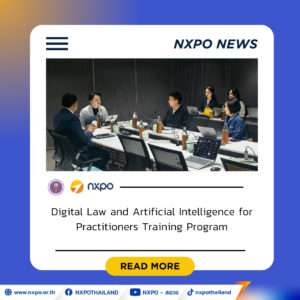
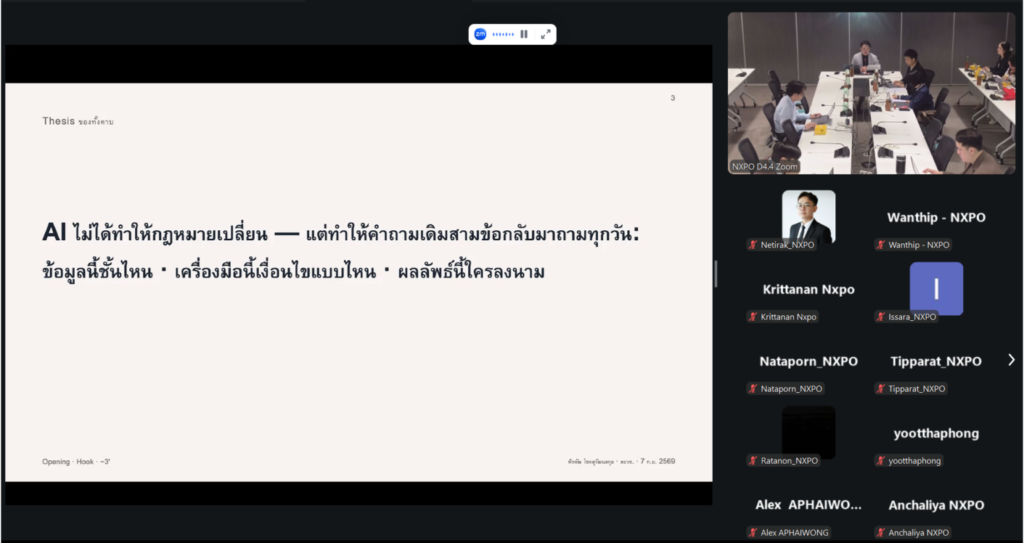
On 7 September 2026, NXPO organized the “Digital Law and Artificial Intelligence for Practitioners” training program for staff members of NXPO and the Research and Innovation Acceleration Agency for Competitiveness and Area Development (RCAD). Asst. Prof. Suppakorn Poonyarith, Vice President of NXPO, delivered the opening remarks, while Asst. Prof. Dr. Peerapat Chokesuwattanaskul of the Faculty of Law, Chulalongkorn University, served as the instructor.


The training aimed to promote the effective use of technology and artificial intelligence (AI) to accelerate and improve the efficiency of data processing and management. It emphasized the importance of legal and regulatory considerations, particularly the Personal Data Protection Act (PDPA) and laws governing official information and government confidentiality. The program also introduced the four core functions of the NIST AI Risk Management Framework (AI RMF)—Govern, Map, Measure, and Manage. The training further explored real-world workplace applications and case studies, including meeting transcription, public relations content creation, and risk management associated with Shadow AI. These examples provided practical guidance on selecting appropriate AI tools and user accounts and using them safely and responsibly in accordance with personnel’s roles and responsibilities.


In his opening remarks, Asst. Prof. Dr. Suppakorn emphasized that, while AI can be leveraged to enhance organizational efficiency, organizations must also take a comprehensive approach to legal compliancen and accountability. Asst. Prof. Dr. Peerapat recommended that organizations establish clear internal AI policies, particularly by defining the scope of permitted tools and establishing processes for reviewing and validating AI-generated outputs. Such measures are essential to effectively manage AI-related risks.
The training is expected to help establish practical guidelines for personnel, laying a foundation for further innovation-driven improvements in work processes while safeguarding organizational data and ensuring compliance with applicable laws and regulations.