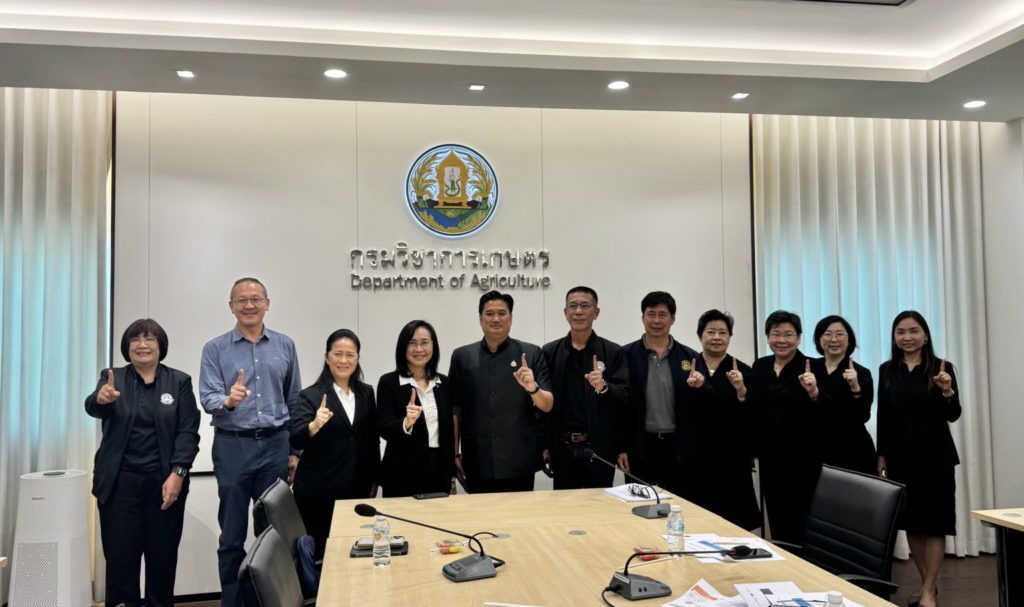
On 26 June 2026, the Ministry of Higher Education, Science, Research and Innovation (MHESI) and the Ministry of Agriculture and Cooperatives (MOAC) convened a strategic meeting to formulate a systematic approach for advancing safe agricultural microbial innovation. The initiative supports the government’s “Market-Driven Research, Innovation for Value Creation” policy, which aims to maximize the impact of MHESI-funded research while strengthening and complementing the work of MOAC. The meeting was co-chaired by Mr. Rapibhat Chandarasrivongs, Director-General of the Department of Agriculture, and Prof. Dr. Chutima Eamchotchawalit, Board Member of NXPO.
The collaboration seeks to establish a comprehensive agricultural microbial innovation ecosystem spanning research and development, regulatory oversight, and commercialization. By leveraging the complementary strengths of both ministries, the initiative aims to accelerate the translation of Thailand’s research outputs into practical applications that enhance agricultural productivity and sustainability.
Agricultural microorganisms—particularly biocontrol agents—are recognized as an important tool for improving agricultural productivity while reducing reliance on chemical inputs. They support safer and more sustainable production of Thailand’s major economic crops, including rice, rubber, cassava, oil palm, maize, sugarcane, durian, coffee, and coconut. The initiative is also expected to reduce dependence on imported agricultural inputs while creating new economic opportunities for Thai farmers and agribusinesses. To support implementation, NXPO proposed a framework built around three strategic mechanisms:
- Data for Technology Transfer: Develop a comprehensive microbial database containing genetic, efficacy, and safety information to facilitate product development, technology transfer and product registration.
- Smart Regulation Sandbox and Fast-track Mechanism: Modernize the regulatory system by benchmarking international best practices, identifying regulatory gaps, and establishing a regulatory sandbox together with fast-track approval pathways for high-potential products.
- Demo & Scaling Platform: Create a collaborative platform linking universities, agricultural solution providers, and farmers to demonstrate, validate, and scale up microbial technologies, thereby improving product performance, building user confidence, and promoting wider adoption.
The collaboration is expected to serve as a key catalyst for strengthening Thailand’s agricultural microbial innovation ecosystem. It will increase both the availability and diversity of high-quality biological products while expanding farmers’ access through coordinated collaboration among academia, regulatory agencies, industry, and agricultural service providers. The initiative will also create opportunities for deep-tech startups and university spin-offs to commercialize microbial innovations through an integrated support system covering microbial databases, product registration, field testing, demonstration, and large-scale deployment. Collectively, these efforts will enhance Thailand’s competitiveness, foster a data- and innovation-driven bioeconomy, and contribute to the sustainable transformation of the country’s agricultural sector.