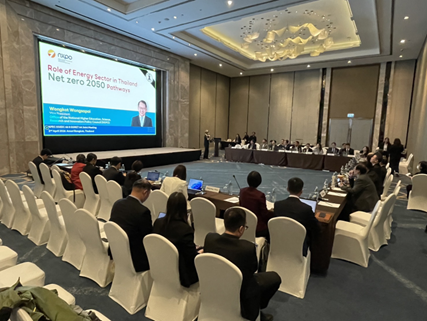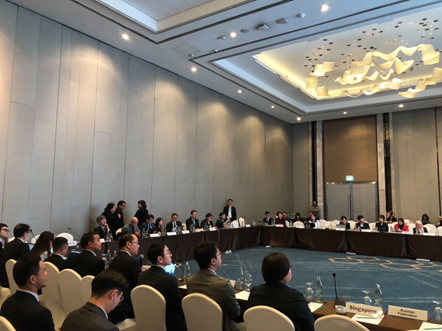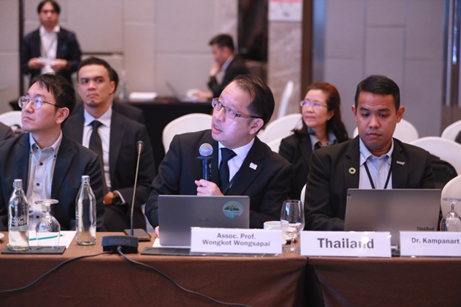
Assoc. Prof. Wongkot Wongsapai, Vice President of NXPO, participated in the 66th Meeting of the Energy Efficiency and Conservation Experts Group (EGEEC 66) and the 64th Meeting of the Expert Group on New and Renewable Energy Technologies (EGNRET 64), under the Asia-Pacific Economic Cooperation Energy Working Group (EWG). Held in Bangkok on 1–2 April 2026, the meetings were convened under the theme “Transforming the energy landscape: accelerating Bio-Circular Economy with clean energy and AI-driven energy efficiency.” The opening ceremony was presided over by Ms. Patcharee Jongrak, Deputy Director-General of the Department of Alternative Energy Development and Efficiency (DEDE), while the closing ceremony was chaired by Mr. Nunthanis Wongvatana, also Deputy Director-General of DEDE. The meetings brought together representatives from APEC member economies, alongside leading energy experts and relevant stakeholders.
The discussions aimed to advance the Bio-Circular-Green (BCG) Economy model across the APEC region, with a strong emphasis on enhancing energy efficiency and expanding the deployment of renewable energy. Key topics included strategies to address rising energy demand, the development of energy standards, and insights into bioenergy trends based on the APEC Bioenergy Outlook report. The report highlights that bioenergy accounts for approximately 61% of global renewable energy supply, particularly in the power generation and transport sectors.
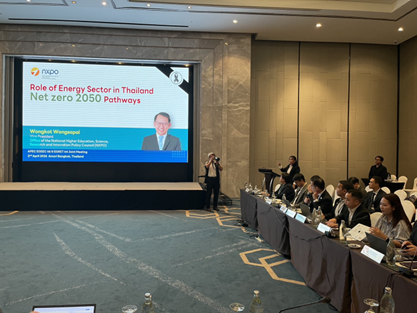
During the sessions, Assoc. Prof. Wongkot delivered a presentation titled “Role of Energy Sector in Thailand Net Zero 2050 Pathways.” He outlined Thailand’s roadmap to achieving net-zero greenhouse gas (GHG) emissions by 2050, targeting a reduction of emissions to 120 MtCO₂eq, alongside an increase in carbon sequestration of 120 MtCO₂eq through Land Use, Land-Use Change and Forestry (LULUCF) and Carbon Capture, Utilization and Storage (CCUS/BECCS). He also presented Thailand’s NDC 3.0 framework (2031–2035), approved by the Cabinet on 4 November 2025, which sets a total emissions reduction target of 109.2 MtCO₂eq. This includes 64.7 MtCO₂eq from unconditional measures and 44.5 MtCO₂eq from conditional measures that rely on international support.
Assoc. Prof. Wongkot emphasized the need for an integrated approach, combining a range of key technologies—including renewable energy, hydrogen, CCUS/BECCS, small/micro modular reactors (SMR/MMR), sustainable aviation fuel (SAF), and electric vehicles (EVs). These solutions must be systematically deployed across the power, industrial, and transport sectors.
He further highlighted NXPO’s role as host of the APEC Center for Technology Foresight (APEC CTF), which supports innovation and human capital development—critical pillars of the Energy Transition Index framework developed by the World Economic Forum. In addition, he presented an investment framework for achieving Net Zero 2050, structured by risk levels and investment scope, encompassing both commercially available technologies and those still in development.